The Best AI Training Platforms in 2026: An Honest Roundup
· 12 min read · OneRange
A vendor-written but honest comparison of the best AI training platforms for enterprises — OneRange, Section, Correlation One, Uplimit, Go1, Coursera, Disco and more, with who each one is actually for
Full disclosure before anything else: we make one of the platforms on this list. OneRange builds Vero, an AI training and skills assessment platform. You should read this the way you'd read any vendor's roundup — with suspicion — which is exactly why we've tried to be specific about where competitors beat us and who should not buy from us.
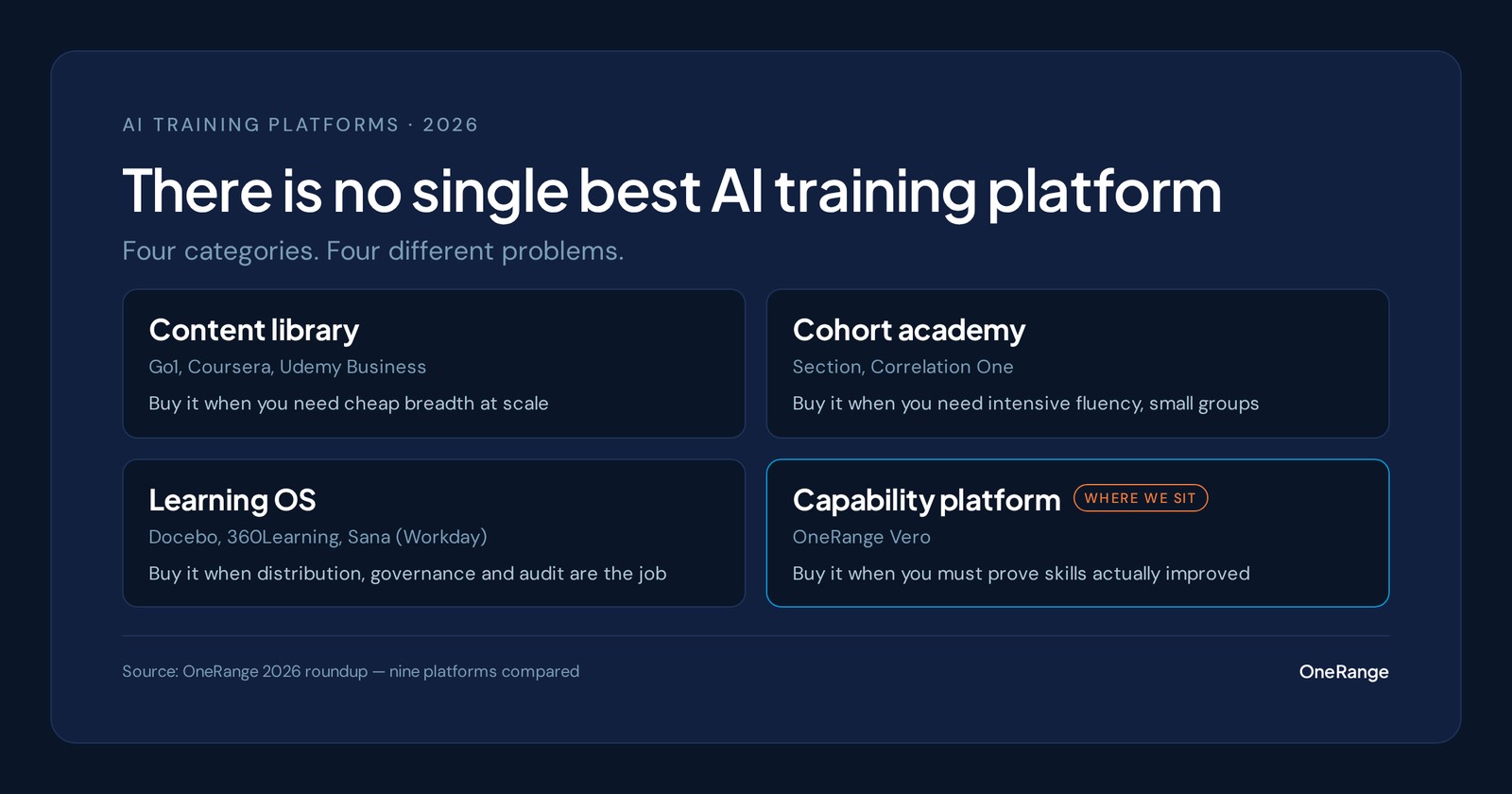
The market for AI training platforms splits into categories that get lumped together in most listicles and shouldn't be. Content libraries, cohort academies, learning operating systems and capability platforms solve different problems. Buying the wrong category is a more expensive mistake than picking the wrong vendor within a category, so this guide starts there.
The 2026 shortlist at a glance
| Platform | Category | Best for | How training is delivered | Measures skill? | Pricing model |
|---|---|---|---|---|---|
| OneRange (Vero) | Capability platform | Role-specific AI training grounded in your own docs, with provable proficiency gain | Adaptive AI training sessions | Yes — proficiency levels against a 10,000+ skill taxonomy | Custom quote per organization (see pricing) |
| Section | Cohort academy | Waking up a leadership team on AI in weeks | Instructor-led cohorts on a calendar | No per-person proficiency baseline | Per seat, per program |
| Correlation One | Cohort academy | Taking analysts to genuine technical data/AI competence | Instructor-led technical programs | Program assessments, not a live skill record | Per learner, program-based |
| Uplimit | Cohort-native platform | In-house experts who want to teach modern courses | Interactive cohort courses you author | Course-level, not skill-level | Platform subscription |
| Sana (now part of Workday) | Learning operating system | Workday-centric enterprises wanting AI search and assistants over internal content | Assistant plus hosted content | Completion-centric | Enterprise subscription |
| Go1 | Content library | Cheap breadth across compliance, soft skills and tooling | Third-party courses piped into your LMS | No | Per seat, catalog subscription |
| Coursera / Udemy Business | Content library | Credentialed self-directed learning | Marketplace video courses | Course quizzes and certificates | Per seat |
| Disco | Community learning | External academies, partner and customer education | Social, community-led programs | No | Platform subscription |
| Docebo / 360Learning | Learning operating system | Enterprise distribution, compliance and audit | Whatever content you bring | Completion-centric | Enterprise subscription |
Categories first, vendors second. Vendor facts current as of August 2026.
The four categories, and how to tell which one you need
- Content libraries: thousands of pre-built courses you subscribe to. Best when you need breadth cheaply and don't need the training to reflect how your company works
- Cohort academies: instructor-led programs with a fixed calendar and peer cohorts. Best for executive fluency, culture change and high-touch upskilling of a small group
- Learning operating systems: modern LMS platforms that host, assign and track whatever content you bring. Best when your problem is distribution and compliance, not authoring
- Capability platforms: assess skills, generate role-specific training grounded in your own knowledge, re-measure proficiency. Best when you must prove capability gain, not attendance
One quick test: if your executive sponsor will accept a completion report, buy a library or an LMS and stop reading. If they will ask "did people actually get better, and how do you know?", you need assessment at the center, which narrows the field considerably.
1. OneRange (Vero) — capability platform
Our own product, so weight accordingly. Vero assesses skills against a large skills taxonomy, generates role-specific courses in minutes from a prompt plus your connected documentation, delivers them as adaptive AI training conversations rather than video, and reports proficiency uplift, time to competency and skill-gap closure.
- Strongest at: role-specific AI training at scale, assessment-first programs, grounding training in internal GitHub/Notion documentation, proving ROI to a finance-minded sponsor
- Weaker at: polished cinematic course production, huge off-the-shelf compliance libraries, instructor-led cohort logistics
- Best fit: companies with 100+ employees, real internal documentation, and many job families needing different training
- Poor fit: teams who want to buy a catalog and be done, or who need SCORM-heavy regulated compliance workflows as the primary use case
Vero is quoted per organization rather than sold in published tiers — see pricing — and the full architecture, from assessment through analytics, is on the platform page.
2. Section — executive AI fluency cohorts
Section runs sharp, opinionated cohort programs aimed at getting leaders and knowledge workers using AI tools quickly. The teaching quality and marketing are both excellent, and for a leadership team that needs to be shaken awake in a few weeks, that format works.
The trade-offs are structural rather than quality-related: cohort programs are priced per seat per program, they run on a calendar, and the content is the same for every customer. There's no assessment layer that gives you a per-person proficiency baseline, and nothing grounds the material in your internal systems. Great for fluency, not a fit for company-wide skills infrastructure.
Side by side, in detail: OneRange vs Sana covers the same trade-off on the platform side.
3. Correlation One — technical data and AI academies
Correlation One runs rigorous, instructor-led data and AI programs, often at large scale for enterprises and government. If you need to take a group of analysts to genuine technical competence in Python, ML or applied data work, they are among the strongest options available and their outcome track record is real.
The cost per learner is a different order of magnitude from software, the programs run for weeks, and they are not the answer for teaching 4,000 employees basic prompting hygiene. Many companies use them for a technical cohort and something lighter for everyone else.
4. Uplimit — cohort-native learning platform
Uplimit built a genuinely modern platform for interactive, cohort-based courses, with AI-assisted authoring and strong engagement mechanics. If you have in-house experts who want to teach and you want their courses to feel like 2026 rather than 2012, it's a good pick.
It's a platform for people who intend to build and run courses. If your constraint is that you don't have instructional capacity or subject-matter experts with spare time, that model transfers the work back to you.
Also worth reading: OneRange vs Uplimit if cohort authoring is the sticking point.
Sana (now part of Workday) — learning operating system
Sana was acquired by Workday and now sits inside that suite, which changes the buying decision more than the product does. The AI assistant over internal content and the authoring experience remain among the most polished in the category, and for organizations already standardized on Workday the integration story is hard to argue with.
The architecture is still content-and-completion with AI layered on: you get better search, summarization and authoring, not a per-person skill record that moves as people train. Buy it as a modern learning system of record, not as a measurement layer. Detail: OneRange vs Sana.
5. Go1 — content aggregation at scale
Go1 aggregates enormous volumes of third-party content and pipes it into whatever LMS you already run. For breadth — compliance, soft skills, tooling, several languages — it's hard to beat on cost per available course.
It is a library, and the standard library problem applies: your competitors can subscribe to exactly the same catalog, and nothing in it references your workflows. Curation becomes the job. Pair it with something that assesses, or you'll have a very large catalog and no idea whether it helped.
6. Coursera for Business / Udemy Business — credentialed breadth
University- and vendor-branded certificates (Google, DeepLearning.AI, IBM) carry weight with employees and are excellent for self-directed learners who want a credential. Coverage of AI fundamentals is deep and constantly refreshed.
Completion rates for self-serve enterprise licenses are famously low without a program wrapped around them, and no marketplace course knows anything about your business. Treat these as a benefit and a supplement, not as your AI enablement strategy.
7. Disco — AI-native community learning
Disco is strong where learning is social: academies, member communities, partner and customer education. The AI features assist with authoring and operations, and the community layer is a real differentiator for programs where peer interaction is the product.
For internal workforce capability measurement, it's a different shape of tool. If you're training an external audience or running a community-driven academy, it belongs on your shortlist ahead of most names here.
8. Docebo / 360Learning — the modern LMS incumbents
Both have added meaningful AI features on top of mature learning management systems, and both are safe enterprise choices with the integrations, compliance workflows and admin depth that large organizations need. 360Learning's collaborative authoring is genuinely good at getting internal experts to contribute.
The underlying architecture is still course-and-completion. AI is a feature set on top of a system of record rather than an assessment-first design. If your primary need is distribution, governance and audit, that's the correct architecture and you should buy it.
Detailed head-to-heads: OneRange vs Docebo, OneRange vs 360Learning, OneRange vs Absorb, and OneRange vs Arist. If you're weighing AI assistants rather than platforms, OneRange vs ChatGPT and Claude covers where those tools fit alongside a training program. The full set lives on the comparison hub.
How to actually evaluate any of them
Vendor demos are optimized. These questions are harder to stage, and they apply to us too:
- Can you assess a skill without first building a course around it? Ask to see it live
- Show me a per-person, per-skill proficiency level — before and after — from a real customer, not seeded demo data
- Connect one of my documents during the call and generate training that references it correctly
- How long from "we need a course on X for this role" to a publishable draft? Time it
- What happens automatically the day after someone scores poorly?
- What's the fully loaded first-year cost: license, AI usage, content, internal authoring hours, integration?
- Who owns the data, and what happens to generated content if we leave?
A shortlist by situation
- Need leadership AI fluency in six weeks: Section, or a Correlation One executive program
- Need deep technical data/AI skills for a specific team: Correlation One
- Need broad, cheap coverage across thousands of employees: Go1, Coursera or Udemy Business
- Need internal experts to teach engaging cohort courses: Uplimit or 360Learning
- Need external/community academies: Disco
- Need enterprise distribution, compliance and audit: Docebo or 360Learning
- Need role-specific training grounded in your own docs plus provable proficiency gain: OneRange
Plenty of companies buy two: a library or LMS for breadth and compliance, and a capability platform for the roles where competence actually has to be demonstrated. That's usually cheaper than forcing one tool to do both badly.
Before you shortlist anyone, know your baseline
The most common reason AI training procurement goes wrong is that nobody measured where the organization was before buying. Run a readiness check first — it takes fifteen minutes, it's free, and it will change your requirements document.
Run a free AI readiness assessment
Keep reading
- How to train employees on AI — the complete guide: https://onerange.ai/blog/how-to-train-employees-on-ai
- AI training platforms vs traditional LMS: https://onerange.ai/blog/ai-training-platform-vs-traditional-lms
- OneRange vs Uplimit: https://onerange.ai/blog/onerange-vs-uplimit
- OneRange vs Section: https://onerange.ai/blog/onerange-vs-section
- What is AI readiness: https://onerange.ai/resources/ai-readiness
- AI skills training by role: https://onerange.ai/for/ai-skills
Tags: Comparisons, AI, Learning & Development
FAQ
Frequently asked questions
What is the best AI training platform for a large enterprise?
It depends on which problem you're solving. For distribution, compliance and audit across thousands of employees, a learning operating system such as Docebo, 360Learning or Sana (now part of Workday) is the right architecture. For proving that specific roles gained specific skills, a capability platform with assessment at the center — OneRange Vero — fits better. Many large enterprises run both.
How much do AI training platforms cost?
Pricing models differ more than headline numbers. Content libraries and learning operating systems are sold per seat per year. Cohort academies are priced per learner per program and cost an order of magnitude more per head. OneRange Vero is quoted per organization based on scope rather than published tiers. When comparing, price the fully loaded first year: license, AI usage, content, internal authoring hours and integration.
What's the difference between an AI training platform and an LMS?
An LMS is a system of record: it hosts, assigns and tracks content you supply, and reports completion. An AI training platform generates and adapts the training itself, and the assessment-first ones report proficiency per skill rather than course completion. Adding AI features to an LMS improves search and authoring; it does not change what the system measures.
Is Sana still independent in 2026?
No. Sana is now part of Workday. The product remains strong for organizations standardized on Workday, but the buying decision is now a suite decision as much as a product one.
Do we need a separate platform just for AI skills?
Not necessarily a separate one, but you do need one that can measure. The common failure is buying breadth — a large catalog of AI courses — and having no way to answer whether capability improved. Whatever you buy, make sure something in your stack produces a per-person, per-skill signal you can trend over time.
How should we evaluate AI training vendors?
Make them do the work live: assess a skill without first building a course around it, show a real before-and-after proficiency level from a customer rather than seeded demo data, connect one of your documents during the call and generate training that references it correctly, and state what happens automatically the day after someone scores poorly.
Related
- Compare OneRange with other platforms — Head-to-head breakdowns against the vendors that show up on the same shortlist.
- OneRange Vero: interactive AI training — Interactive AI training built from your own source material and adapted to every role and level.
- ready-made AI course catalog — Courses, skill assessments, pathways, and certifications, grouped into tracks and ready to assign.