How to Train Employees on AI: The Complete Guide
· 14 min read · OneRange
A step-by-step guide to AI training for employees: how to set outcomes, assess baseline skills, build role-specific curricula, run the rollout, and measure real proficiency gains
Almost every company has now bought AI tools. Far fewer have trained anyone to use them. The predictable result: licenses go unused, a small group of self-taught power users pulls ahead, and leadership cannot tell whether the investment produced anything. Training is the step that converts AI spend into AI capability, and it is the step most organizations skip or improvise.
This guide covers how to train employees on AI end to end — deciding what "trained" means for your business, assessing where people actually are, designing role-specific curricula, running the rollout, handling governance and resistance, and measuring proficiency rather than attendance. It is written for the person who owns the program: an L&D lead, a head of enablement, a CTO, or an operations leader who inherited the mandate.
Start with outcomes, not tools
The most common failure mode in AI training is teaching the tool. A ninety-minute session on ChatGPT's interface produces a room full of people who can open ChatGPT. It does not produce anyone who has changed how they work.
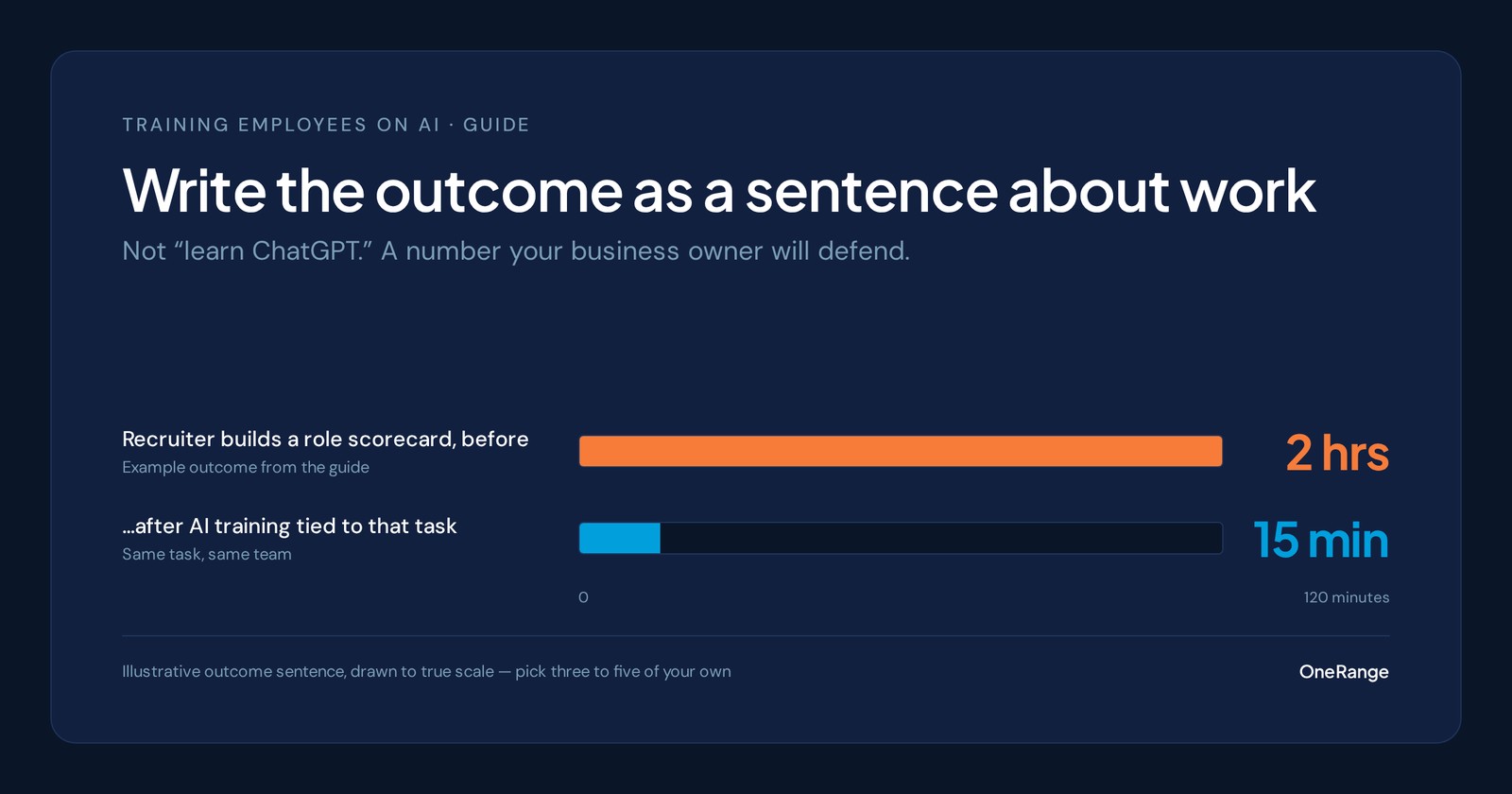
Write the outcome as a sentence about work: "Our support team resolves tier-one tickets 30% faster using AI-drafted responses reviewed by a human." "Our recruiters produce role scorecards in 15 minutes instead of two hours." "Our engineers use AI code assistance without leaking proprietary context." Each of those implies a different curriculum, a different tool, and a different definition of done.
- Pick three to five outcomes tied to teams that already feel a bottleneck
- Attach a number to each one, even a rough baseline you can defend
- Name the business owner for each outcome — not the L&D owner
- Sequence them: one flagship team first, then expand on evidence
If you cannot write the outcome sentence, you are not ready to train. You are ready to run discovery interviews with the teams whose work you intend to change.
Define the AI skills that matter at your company
"AI skills" is not one skill. In practice it decomposes into four layers, and most employees only need the first two.
- AI literacy: what generative models are, what they do well, where they hallucinate, what data must never go in, how to read a confidence signal
- Applied prompting: task framing, context supply, iteration, output verification, and knowing when the AI answer is worse than doing it yourself
- Workflow integration: embedding AI into a specific job process — drafting, summarizing, coding, analysis, research — including the handoffs and review steps
- Building: agents, automations, retrieval over internal documents, evaluation of outputs at scale — relevant to a small technical minority
Map each job family to a target layer. A field sales rep needs layers one and two. A support lead needs one through three. A data engineer needs all four. Training everyone to the same depth wastes the majority's time and underserves the minority who could actually build things.
See how AI skills training works in OneRange
Assess before you teach
Skipping the baseline is the single most expensive shortcut in AI enablement. Without it you cannot personalize, you cannot prove improvement, and you will spend budget teaching people things they already know.
A useful baseline assessment measures three things: conceptual understanding (does this person know what a model can and cannot be trusted with), applied skill (can they get a usable output from a realistic task), and judgment (do they verify, and do they know what not to paste into a chat window). A ten-question multiple-choice quiz measures only the first.
Better formats exist and are worth the extra design effort: a short hands-on task graded against a rubric, a role-play where the learner has to catch a plausible-sounding wrong answer, or a work-sample review. Modern assessment platforms — including ours — can generate these per skill and score them consistently, so the cost objection largely disappears.
- Assess at the individual level and report at the team level
- Separate confidence from competence — self-ratings correlate poorly with performance
- Re-run the same assessment 60 to 90 days after training to produce an uplift number
- Keep it short. Fifteen minutes per person is the realistic ceiling for voluntary participation
Run a free AI readiness assessment
Design the curriculum by role, not by department
Departments are org-chart artifacts. Roles are what determine whether AI training lands. Two people in the same marketing team — a content strategist and a marketing ops analyst — need almost entirely different training.
A workable structure for most companies is three tiers on top of a shared foundation:
- Foundation (everyone, 60–90 minutes): AI literacy, the company's acceptable-use policy, data handling rules, and one hands-on exercise in the tool you actually licensed
- Applied track (role-specific, 3–5 hours over several weeks): the four or five workflows in that role where AI produces the biggest gain, taught with the team's own documents and examples
- Practitioner track (opt-in, ongoing): automation, agents, retrieval over internal knowledge, prompt evaluation, and a build project reviewed by peers
- Leadership track (managers, 2 hours): how to spot AI-inflated work, how to set team-level expectations, how to redesign a process rather than speed up a broken one
The applied track carries the value. It is also the part generic course libraries cannot supply, because it depends on your tools, your data, your review standards and your vocabulary. This is why AI training that uses your internal documentation outperforms off-the-shelf content, and why grounding matters more than production polish.
Choose the delivery format honestly
Four formats dominate, each with a real trade-off.
- Live workshops: high energy, good for buy-in and Q&A, expensive to repeat, and completion collapses beyond one session
- Self-paced video courses: cheap to distribute, easy to ignore, almost impossible to assess meaningfully
- Cohort programs: strong accountability and peer learning, hard to schedule across time zones, capped by facilitator availability
- Adaptive AI training: personalized pacing, always available, assessable at the skill level, but requires content grounding to avoid feeling generic
Most successful programs blend them: one live kickoff to establish why this matters and that leadership is serious, then adaptive self-paced work for the applied track, then a live review where teams present what changed in their actual workflow. The presentation at the end is what makes the middle part get done.
Ground the training in your own knowledge
Generic AI training teaches people to prompt a generic model about generic tasks. It is useful for a week. What compounds is training that references your runbooks, your engineering standards, your pricing rules, your escalation policy — so that when someone practices, they practice the way your company works.
Practically, this means connecting the training system to the places your knowledge already lives — a documentation repo, a wiki, a shared drive — with retrieval at training time, permission scoping so people only see what they should, and deletion honored so retired documents stop shaping answers. Companies with several years of internal documentation usually find this is the difference between training that feels like a webinar and training that feels like onboarding.
Write the policy before the rollout
Training without governance produces confident employees doing risky things. Publish the rules first, in one page, in plain language, and teach them in the foundation module.
- Which tools are approved, and which are explicitly not
- What data may never be entered: customer PII, unreleased financials, credentials, third-party confidential material
- When AI output requires human review before it reaches a customer or a system
- Whether AI-assisted work must be disclosed, and to whom
- Who to ask when the rule is unclear — a named person, not a mailbox
The disclosure question is the one most policies fumble. Decide it deliberately: a blanket disclosure requirement is easy to write and quietly ignored, while no requirement at all erodes trust the first time a customer notices. Most companies land on disclosure for external deliverables and silence for internal drafts.
Plan for resistance, because it is rational
Employee hesitancy about AI training is usually not technophobia. It is a reasonable read of incentives: if I get faster, does that mean fewer of us? If I automate part of my job, whose budget grows? Programs that ignore this get polite attendance and no behavior change.
- Say what the productivity gain is for — new capacity, better quality, less after-hours work — and be specific
- Give people time inside working hours. Training assigned as homework signals it is not real
- Celebrate the first team that redesigns a process, not the first person to finish a course
- Do not measure adoption by tool logins. Measure it by work that changed
- Let skeptics test the failure cases in the training itself. Teaching where AI is wrong builds more trust than teaching where it is right
A realistic 90-day rollout
Ambition kills AI training programs more often than skepticism. A tight ninety days on one function beats a year-long enterprise plan that never ships.
- Days 1–15: pick three outcomes, name business owners, publish the acceptable-use policy, baseline-assess one pilot function
- Days 16–30: build the foundation module and one applied track using the pilot team's real documents and workflows
- Days 31–60: run the pilot. Weekly 30-minute clinics. Capture examples of work that changed, with before and after
- Days 61–75: re-assess the pilot cohort, calculate uplift and time saved, and write a one-page result for the executive sponsor
- Days 76–90: expand to two more functions using the evidence, and hand the foundation module to onboarding so every new hire gets it automatically
Put the foundation module into onboarding early. It is the cheapest permanent win in the entire program and it prevents the capability gap from reopening with every hire.
Measure proficiency, not completion
Completion rate is the metric that ends budgets. It tells a CFO that people clicked through something. Four numbers do better, and all four require a baseline.
- Proficiency uplift: per-skill score change from pre-training to 60–90 days post-training
- Time to competency: median days from assignment to demonstrated proficiency, tracked over cohorts so you can see the program improving
- Skill-gap closure: percentage of the target-role skill profile now met across the team
- Applied outcome: the business number from step one — cycle time, ticket resolution, output volume at held-constant quality
Pair the quantitative view with three specific stories of work that changed. Executives fund the numbers, but they remember the examples, and the examples are what get the next function to volunteer.
Common mistakes to avoid
- Training the tool instead of the workflow — the tool will change within a year, the workflow will not
- One-size-fits-all curricula that bore the advanced and lose the beginners
- No baseline, therefore no provable result and no second year of funding
- Prompt-library handouts with no practice — copied prompts do not build judgment
- Ignoring managers, who then fail to reinforce anything the training asked for
- Treating governance as a legal appendix rather than a taught module
- Declaring victory on license activation instead of demonstrated capability
How OneRange approaches this
We build Vero, an AI training platform, so this section is a vendor argument — treat it accordingly. The design follows the guide above: assess skills first against a large skills taxonomy, generate role-specific training grounded in your own connected documentation, deliver it as an adaptive conversation rather than a video, and report uplift, time to competency and gap closure rather than completions.
The practical reason companies use it for AI enablement specifically is speed of authoring. Fourteen job families each needing a different applied track is an impossible instructional-design budget and a routine afternoon of drafting-plus-human-review on a generation-based platform.
AI skills training for every team
Once you know what to teach, the harder question is what to buy: our roundup of the best AI training platforms in 2026 compares the options by category.
Keep reading
- The best AI training platforms in 2026: https://onerange.ai/blog/best-ai-training-platforms
- AI skills training by role: https://onerange.ai/for/ai-skills
- What is AI readiness — the complete guide: https://onerange.ai/resources/ai-readiness
- Free interactive AI readiness assessment: https://onerange.ai/resources/ai-readiness-assessment
- AI ROI calculator: https://onerange.ai/resources/roi-calculator
- AI training platforms vs traditional LMS: https://onerange.ai/blog/ai-training-platform-vs-traditional-lms
- The OneRange platform: https://onerange.ai/platform
Tags: AI, Learning & Development, Guides
Related
- What AI fluency actually means — The working definition, the four capability bands, and how to measure fluency across a workforce.
- OneRange Vero: interactive AI training — Interactive AI training built from your own source material and adapted to every role and level.
- AI fundamentals training for every employee — Twenty-one ready-to-assign courses that take a workforce from a first conversation with AI to safe, productive daily use.