AI LMS vs Traditional LMS: The Honest Buyer's Comparison
· 9 min read · OneRange
AI LMS vs traditional LMS: how the two categories differ on content generation, personalization, assessment, analytics and total cost — and when the traditional LMS is still the right call
Most organizations evaluating an "LMS alternative" are not unhappy with their learning management system's uptime. They are unhappy with what it produces. Courses take months to author, completion rates are the only number anyone can report, and the content is already out of date by the time it is published. Meanwhile the skills the business needs — AI fluency, data judgment, new tooling — change faster than any authoring cycle can keep up with.
This is a commercial comparison of two categories: the traditional LMS and the AI training platform. We build one of the latter (OneRange Vero), so treat this as a vendor's argument and pressure-test it. We have tried to be specific enough that you can verify each claim on your own demo calls, and honest about where an LMS still wins.
What each category is actually optimized for
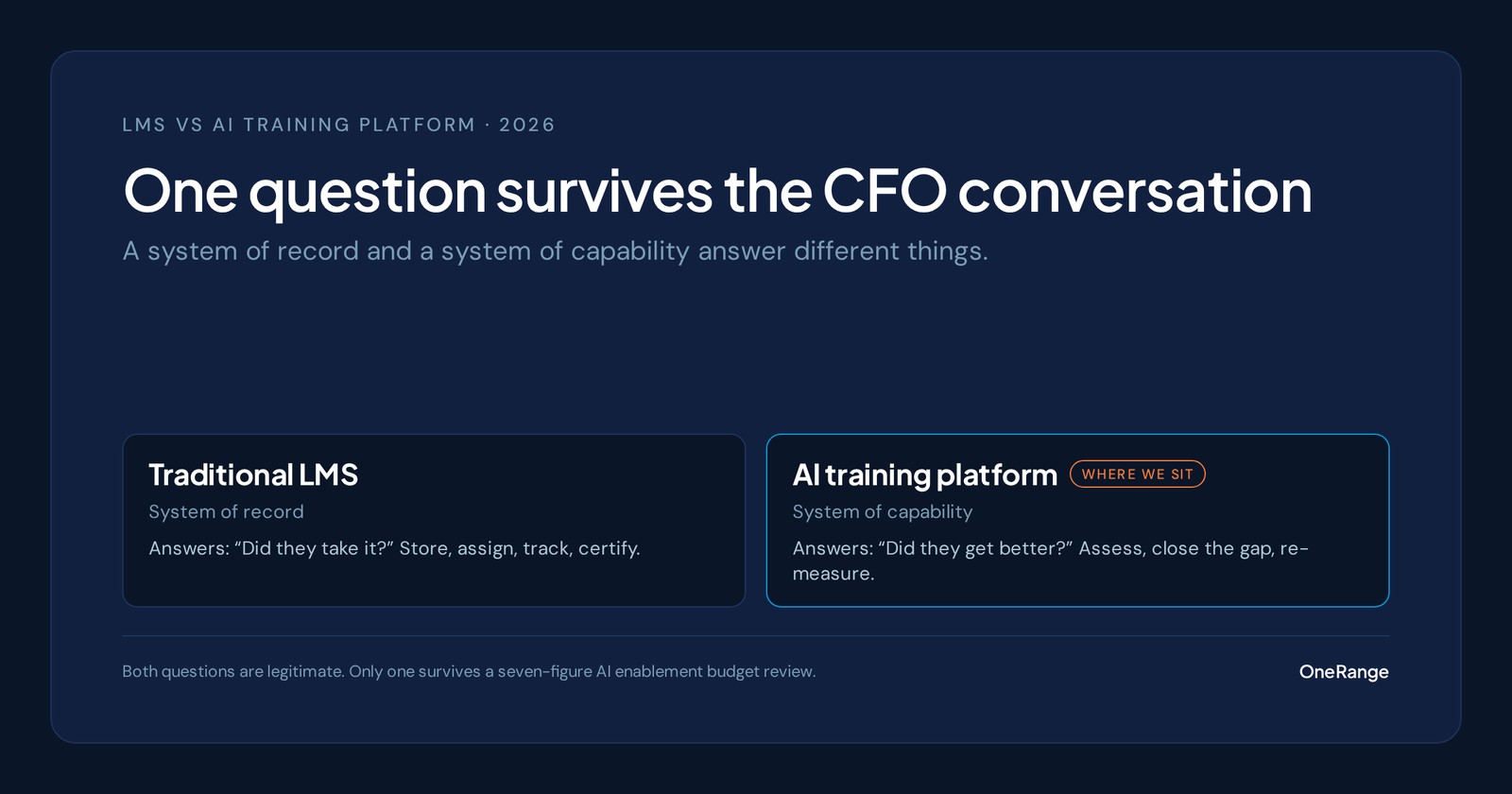
A traditional LMS is a system of record for training. Its core job is to store courses, assign them, track who finished, and prove to an auditor that the assignment happened. Every design decision follows from that: SCORM packages, catalogs, enrollment rules, completion reporting, compliance certificates. On those terms, a mature LMS is excellent and has been for twenty years.
An AI training platform is a system of capability. Its core job is to determine what someone can do, generate or adapt training to close the gap, and re-measure. Content is an output, not an inventory. That difference shows up in every column of the comparison below.
If you remember one thing: an LMS answers "did they take it?" An AI training platform answers "did they get better?" Both are legitimate questions. Only one of them survives a CFO conversation about a seven-figure AI enablement budget.
Content creation: authoring cycles vs generation
In an LMS, content is procured or authored. A typical internal course runs through subject-matter-expert interviews, an instructional designer, a storyboard, media production, SCORM packaging and QA. Realistic timelines run six to twelve weeks per course, and industry cost benchmarks for a single hour of finished e-learning routinely land in the thousands to tens of thousands of dollars. Off-the-shelf libraries shortcut that, at the price of being identical for every buyer.
On an AI platform, you describe the outcome, the target role and the duration, and the system drafts the topic outline, interactive elements, a knowledge check and an optional diagnostic baseline. In Vero that draft is produced in minutes and stays in ephemeral state until a human clicks confirm and publish, so nothing reaches learners unreviewed. Editing a published course bumps a version, and employees mid-course keep credit for what they already completed.
The honest trade-off: instructional designers produce better-crafted narrative and media than any generator does today. Generation produces something specific and current in an afternoon. If your bottleneck is polish, keep the designers. If your bottleneck is that fourteen job families each need different training and you can fund three courses a year, generation is the only economically viable path.
Personalization: assignment rules vs adaptive AI training
LMS personalization is routing. Rules assign a fixed course to a group based on department, location or job code. Everyone in the group gets the same asset in the same order. It is deterministic, auditable and completely blind to what the individual already knows.
AI platforms personalize inside the session. Vero delivers training as a conversation that adjusts to the learner's answers — explain, example, check — with interactive choices, an embedded code editor for technical exercises, image uploads for visual work, and voice playback. Someone who demonstrates mastery early moves on; someone struggling gets a second framing rather than the same slide again.
The practical consequence is time. A ten-person team no longer sits through the same forty-minute module when four of them already knew the material. That reclaimed time is usually a larger financial line item than the software itself.
Assessment: completion vs proficiency
This is the widest gap in the category, and the one worth the most in a budget conversation.
An LMS records completion and, at best, a post-course quiz score. Completion tells you attendance. A quiz score tells you recall on the day. Neither tells you whether anyone can do the work.
An AI training platform can treat assessment as its own product surface. In Vero, assessments run independently of any course: four AI-generated questions per skill against a 10,000-skill taxonomy, delivered as a multiple-choice quiz, a graded hands-on lab, a code project or an AI role-play scored against a rubric. You get a proficiency level per skill per person, before and after, and a verifiable credential tied to demonstrated ability rather than seat time.
- Ask any vendor: can I assess a skill without first building a course around it?
- Ask: do I get a per-skill proficiency level per person, or a cohort average?
- Ask: can the same skill be evaluated through a lab or role-play, not only a quiz?
- Ask: what happens automatically the day after a low score — is training assigned, or does someone have to notice?
Knowledge grounding: your documents, or generic content
Generic training is a commodity and it gets cheaper every quarter. The durable reason to pay for a platform is training on how your company does the work.
An LMS stores whatever you upload, but the course cannot reference your deployment runbook while a learner is mid-question. An AI platform with a retrieval layer can. Vero syncs GitHub and Notion incrementally on content hashes, avoids duplicate imports, honors deletions so retired documents stop influencing training, and retrieves relevant passages at training time — scoped strictly to your company at the database layer. One customer has roughly 1,600 internal documents addressable inside every session.
Discount this honestly if your documentation is thin or scattered. If you have years of playbooks, engineering docs and process guides sitting in Notion and GitHub, it is the single largest differentiator between the two categories.
Analytics: activity reporting vs ROI
LMS dashboards report activity: enrollments, completions, time in platform, overdue assignments. Useful for compliance, insufficient for investment defense.
Capability platforms report movement. OneRange splits workforce analytics by hard and soft skill, by team and by business function, with four deliberately chosen ROI metrics: proficiency uplift, time to competency, skill-gap closure and training efficiency. Internal mobility — promotions and lateral moves — is tied back to the training that preceded it.
The caveat applies to us as much as anyone: those numbers are only as good as your assessment discipline. Skip the baseline and uplift is unmeasurable, and our dashboard is as thin as anybody's. Ask every vendor, including us, to show a real customer's first 90 days with the seeded demo data switched off.
Total cost of ownership
Per-seat license fees are the smallest line in most L&D budgets. The comparison that matters is the fully loaded cost of getting a person to demonstrated competence:
- LMS: platform license + content library subscription + internal authoring labor + instructional design + SCORM production + annual content refresh + admin overhead
- AI platform: platform license (AI usage bundled or metered — confirm which) + human review time per generated course + integration setup + admin overhead
- Hidden LMS cost: content that goes stale between refresh cycles, which is severe for anything AI-related where tooling changes quarterly
- Hidden AI-platform cost: metered token overages and the review burden if nobody owns quality control. OneRange includes AI usage in the seat price and monitors per-organization consumption internally rather than sending surprise overages
Reduce everything to one number and make each vendor model it with your headcount: cost per employee who provably moved up a proficiency level. A refusal to model that is itself an answer.
When the traditional LMS is still the right buy
We would rather you buy correctly than churn in two quarters. Stay with your LMS, or buy one, if:
- Your dominant use case is regulatory compliance training with fixed, audited content and certification records
- You are in a regulated industry where every learner must receive provably identical material
- You have a large existing SCORM library with real sunk value and no appetite to migrate
- Your reporting obligation genuinely is completion — to a regulator or an auditor, not to a CFO
- You have no internal owner willing to review AI-generated content before publication
When an AI training platform wins
- Skills change faster than your authoring cycle can produce courses — AI tooling, data, engineering practice
- Dozens of job families each need different training and a fixed catalog cannot economically serve them
- Leadership is asking what the enablement budget returned and completion rates are no longer accepted
- You have substantial internal documentation that should shape how training is delivered
- You need proficiency measured per skill, before and after, with credentials that mean something
- You are training technical and semi-technical roles where labs, code projects and role-plays beat lectures
You can run both
Replacement is not the only path, and pretending otherwise would be dishonest. A common pattern: keep the LMS as the compliance system of record, and run capability development on an AI platform alongside it. Vero exports SCORM so generated content can be delivered through an existing LMS when policy requires it, while assessment and analytics stay where they are actually useful.
If you split the stack, insist that outcomes on both sides can be expressed as the same skills, or you will end up with two systems whose reports never reconcile.
A 30-day evaluation you can actually run
- Pick one job family with a real, current skill gap — not a generic pilot population
- Baseline them with a per-skill assessment before any training happens
- Have each vendor produce training for that exact gap, using your documentation, on the call
- Run it, then re-assess the same skills with the same instrument
- Compare proficiency movement and hours consumed, not satisfaction surveys
Any platform that cannot survive that sequence is selling you a content library with a dashboard attached.
The bottom line
A traditional LMS is the right tool for proving training happened. An AI training platform is the right tool for proving capability changed. If your budget this year is being spent on AI enablement, the second question is the one you will be asked to answer — and a completion percentage is not an answer to it.
If you're shortlisting vendors on the back of that decision, our roundup of the best AI training platforms in 2026 splits the market into content libraries, cohort academies, learning operating systems and capability platforms.
New to the category language? What is an AI LMS? defines the term, separates the AI features that change outcomes from the ones that only change the marketing, and gives you a checklist to run on any demo call.
Tags: Comparisons, Learning & Development, AI
Related
- Compare OneRange with other platforms — Head-to-head breakdowns against the vendors that show up on the same shortlist.
- OneRange Vero: interactive AI training — Interactive AI training built from your own source material and adapted to every role and level.
- What is an AI LMS? — Where an AI LMS ends and a capability platform begins.