AI Training Is Going to the People Who Need It Least
· 8 min read · OneRange Research
83.5% of senior leaders have had AI training at work; 45% of entry-level staff have. How to flip the gap so the people doing the work get trained.
Ask who in your company has been trained on AI and the answer is usually the leadership team. They sat through the vendor briefing, the board session, and the offsite workshop. Then ask who uses AI for several hours a day, and the answer is a marketing coordinator, an analyst, a recruiter, and a customer support rep, most of whom learned it from a colleague or from the tool itself.
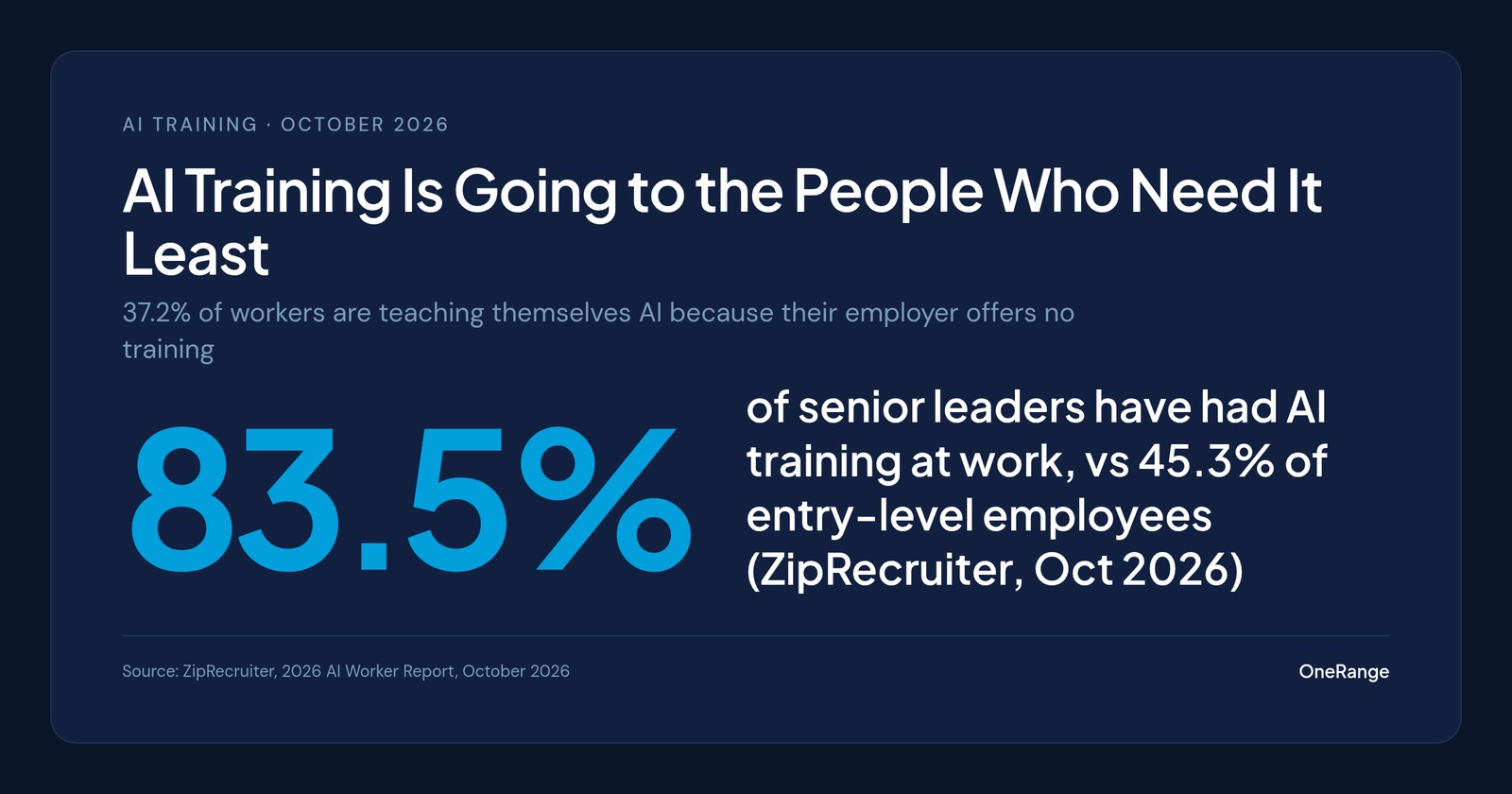
New data from ZipRecruiter puts numbers on that mismatch. In its 2026 AI Worker Report, released this week, 83.5% of senior leaders (directors, VPs, and the C-suite) said they have had some form of AI training at their company. Among individual contributors the figure was 46.4%, and among entry-level workers 45.3%. Across the whole workforce, 62.8% have had any AI training, but only 28.9% say they receive enough, and 37.2% learn the tools entirely on their own because their employer provides none. Among entry-level workers, 54.7% are self-taught.
That is the wrong way up. Leaders need enough AI fluency to set policy, fund the right things, and judge results, which is a short course. The people who produce the work need the most hours, because they are the ones briefing the tool, checking its output, and deciding what goes out the door. This post covers what the training gap looks like, why it is expensive, and how an HR or L&D team at a 50 to 2,500-person company can flip it in a quarter, using AI fundamentals training for every employee as the base layer.
What the AI training gap looks like
- 83.5% vs 45.3% — Senior leaders vs entry-level employees who have had any AI training at their company (ZipRecruiter, 2026 AI Worker Report, Oct 2026)
- 37.2% — Workers who learn AI tools entirely on their own because their employer provides no training; 54.7% of entry-level workers (ZipRecruiter, Oct 2026)
- 22% — Employers that provide formal, mandatory AI training for all employees; 17% provide none (ZipRecruiter, 2026 AI Employer Report, Jul 2026)
- 45% — Employees who spend an hour or more a week reviewing or fixing colleagues' AI output (Hubstaff, State of the Workweek 2026, Oct 2026)
The gap shows up on both sides of the survey table. On the worker side, training follows seniority. On the employer side, ZipRecruiter's July survey of more than 1,000 talent acquisition professionals and hiring managers found that only 22% of companies provide formal, mandatory AI training for all employees. Another 23% train specific departments only, 34% offer optional resources, and 17% provide nothing. Put the two together and the picture is consistent: a structured program for a few, a link to a video library for everyone else.
AI training follows seniority
- Senior leaders — any AI training: 83.5
- Individual contributors — any AI training: 46.4
- Entry-level — any AI training: 45.3
- All workers — self-taught, no employer training: 37.2
- Entry-level — self-taught, no employer training: 54.7
Share of US workers who have had any AI training at their company, by level, and share who teach themselves because their employer provides none. Source: ZipRecruiter, 2026 AI Worker Report, October 2026 (n=1,500+ US workers, fielded September 8–21, 2026).
It is not that the front line is uninterested. Only 34.3% of workers think they could master AI skills without help, but a further 40.2% say they could if given proper training. That second group is the whole opportunity: four in ten employees who are willing, believe they are able, and are waiting to be shown. Meanwhile 39.3% say their employer actively encourages AI use, which means a good share of companies are asking for something they have not taught.
PwC's Global Workforce Hopes and Fears Survey, which covered 49,364 workers in 48 countries this year, found the same shape at global scale. Nearly 80% of its "front-runners", the 14% of workers with scarce skills and strong AI ability, have access to learning and development resources. Fewer than 40% of its "engine room", the 56% of the workforce with neither, do. Across all workers, the share who rate their access to L&D positively fell from 59% to 51% in a year, while the share who had used AI at work rose ten points to 64%. Use is spreading faster than training, and training is concentrating at the top.
Why an upside-down training gap is expensive
The cost does not appear as a line item. It appears as other people's time. In Hubstaff's State of the Workweek survey of 1,068 full-time US employees in mostly computer-based jobs, published this week, 53% of AI users said they receive AI-generated work from colleagues that needs significant correction at least monthly, and 45% spend an hour or more every week reviewing or fixing it. That is the operational signature of self-taught AI use: inconsistent briefing, unchecked output, and no shared standard for what good looks like. We wrote about this pattern as workslop in October, and the new data says it is still growing.
The same survey found that 46% of AI users say their expected workload has increased since they adopted AI, and ZipRecruiter's employer report found 57% of employers have raised baseline productivity expectations because of it. So the front line is being asked to produce more, with tools it was not trained on, while 44.6% of workers (67.3% of daily AI users) say AI is making their technical skills go out of date faster. Expectations are rising on the people with the least support.
There is a retention cost too. A quarter of workers (25.1%) told ZipRecruiter they plan to leave their current job because of how their employer views or uses AI, and 30.5% want their next role to involve less AI. Training is one of the few levers an employer controls here. Last month we made the case that AI training is now an employee benefit, and the new numbers only strengthen it: the people most likely to be self-taught, entry-level workers and women (45.4% self-teach, against 29.9% of men), are the ones a structured program reaches first.
What leaders need, and what everyone else needs
| Group | What they need to be able to do | Hours | Vero track |
|---|---|---|---|
| Executives and senior leaders | Set the use policy and data rule; decide which teams go first; judge AI-assisted work by its results, not its novelty; model use in their own work | 2–4 hours, once | AI training for managers and leaders |
| Managers | Everything above, plus review a direct report's AI-assisted output, spot unchecked work, and set the standard for their team | 4–6 hours, then monthly practice | AI leadership track plus their team's track |
| Individual contributors and entry-level staff | Brief a task clearly; check what comes back; know what may not go into the tool; turn repeat work into a reliable workflow; recognize when AI is the wrong tool | 8–12 hours over a quarter, with daily practice on real work | AI fundamentals, then a tool or team track |
The hours are ours, not the survey's, and they are deliberately lopsided. A leadership course is short because the leadership job with AI is governance and judgment. The front-line course is longer because the front-line job is production, and production skill only comes from repetition on real tasks with someone checking the result. The ZipRecruiter report itself suggests the disparity may reflect generic, high-level training for leaders versus a need for hands-on, role-specific instruction for front-line staff. That is the right diagnosis. The leadership briefing is not wrong; it is just not the program.
Training should also move past prompting. Demand for people who can apply AI to real workflows has grown while demand for basic prompting has fallen, as we covered in what to train after prompting. For a non-technical team that means the skills in the table: briefing, checking, data discipline, and building a repeatable workflow. Those map onto the four AI fluency skills, and they are learnable by anyone who does the job.
How to flip the training gap in one quarter
- Find out where the gap is. Survey or assess by level and by team, not company-wide. A single "62% trained" number hides an 83/45 split. An AI fluency assessment by skill gives you a baseline you can re-measure
- Give leaders the short course first, and make it the governance course. Policy, data rule, which teams go first, how to judge AI-assisted work. Two to four hours. Its job is to make the rest of the program possible, not to make executives power users
- Start the real hours with the team whose work has already changed. Usually marketing, sales, support, or operations: the people using AI for several hours a day on their own initiative. Train them by role, on their own live work, with a manager reviewing one output per person
- Make it mandatory for the first cohort, not optional. Only 22% of employers run formal, mandatory AI training for everyone; optional resources are what 34% offer, and self-teaching is the result. One cohort, four to six weeks, attendance expected, with a daily task so the skill becomes a habit
- Teach checking as a skill. Give people real examples with an invented statistic, a missing source, and a confident wrong answer, and have them find and fix each one. This is what cuts the hour a week colleagues spend correcting AI output
- Report by level, not by completion. After the first cohort, show the before-and-after assessment by skill for the team that was trained, then present the remaining gap by level to the leadership group that just finished its own course. A leadership team that has been trained will fund the rest
If you already run a structured program for leaders, you are halfway there. The second half is scheduling the same seriousness, with more hours and different content, for the people who report to them. Our 30-60-90 day AI fluency program lays out the quarter in detail.
How Vero by OneRange helps
Vero is interactive AI training built for exactly this split. Each course is a conversation, not a video: the tutor explains an idea, works an example with the person's own kind of task, asks them to try it, and adjusts what comes next to the answer it gets. A recruiter and a finance analyst taking the same course get different examples, which is what role-specific training at front-line scale requires.
- Skill assessments that place every employee at Beginner, Intermediate, Advanced, or Expert for each AI skill, with strengths and areas for improvement, so you can see the gap by level before you spend a training hour and re-measure afterwards with the same instrument
- A short AI training for managers and leaders track that covers policy, judgment, and reviewing AI-assisted work, so the leadership course is a governance course
- AI fundamentals training for every employee as the base layer, then tool tracks such as ChatGPT training for employees and team tracks for marketing, sales, and finance
- Multiple Choice and Open Answer questions, so people are assessed on whether they can brief a task and judge the result, not only on recall
- A custom company layer that puts your own data rule, approved tools, and examples into every session
- Workforce Results for managers, showing who has moved from Beginner to Intermediate, by team and by level, which is the report that closes the gap in the next budget conversation
The companies that get a return on AI are not the ones whose executives have been briefed. They are the ones where the person producing the work knows how to brief the tool, check the answer, and build the workflow. That person is the training program.
See AI fundamentals training in Vero
Sources
- ZipRecruiter Economic Research, Better Work, More to Learn: The 2026 AI Worker Report (Oct 26, 2026) — https://www.ziprecruiter-research.org/economic-insights-research/2026-ai-worker-report
- ZipRecruiter, press release: 53% of Workers Say AI Has Made Their Work More Enjoyable (Oct 26, 2026) — https://www.nasdaq.com/press-release/ziprecruiter-research-53-workers-say-ai-has-made-their-work-more-enjoyable-2026-10-26
- ZipRecruiter Economic Research, More Jobs, Higher Bar: The 2026 AI Employer Report (Jul 29, 2026) — https://www.ziprecruiter-research.org/economic-insights-research/ai-employer-report-2026
- Hubstaff, State of the Workweek 2026 press release (Oct 27, 2026) — https://www.prnewswire.com/news-releases/ai-is-saving-employees-time-but-employers-arent-getting-the-capacity-they-expect-new-hubstaff-research-finds-302920946.html
- PwC, Global Workforce Hopes and Fears Survey 2026 (Sep 29, 2026) — https://www.pwc.com/gx/en/1/issues/workforce/hopes-and-fears.html
Tags: AI, AI Fluency, Learning & Development
FAQ
Frequently asked questions
Who should get AI training first: leaders or employees?
Leaders need enough to set policy and judge results, which is a short course. The people who produce the work need the most hours, because they are the ones using the tools all day. In most companies the split runs the other way: ZipRecruiter found 83.5% of senior leaders have had some AI training at work, against 46.4% of individual contributors and 45.3% of entry-level employees. Start with the teams whose daily output has already changed.
How many employees are teaching themselves AI?
In ZipRecruiter's September 2026 survey of more than 1,500 US workers, 37.2% said they learn AI tools entirely on their own because their employer provides no training. Among entry-level workers it was 54.7%. Self-taught use is uneven and unsupervised, which is how AI output that needs correcting ends up on colleagues' desks.
Does AI training for employees actually make a difference?
Workers say so. Only 34.3% believe they could master AI skills without help, but another 40.2% say they could with proper training. That second group, four in ten of the workforce, is the return on a training program: people who are willing and able but are waiting for someone to show them.
What does role-specific AI training look like for non-technical teams?
Exercises on the person's own recurring work, not a tour of features. A marketer drafts and checks a campaign brief; an analyst cleans a spreadsheet and verifies the result; a recruiter writes a job description and checks it for claims it cannot support. Each role practices briefing the tool, checking what comes back, and deciding what to use. OneRange Vero's catalog tracks are organized this way, by tool and by team.
How do you know whether the training gap is closing?
Assess AI fluency by skill before training and again afterwards, with the same instrument, and report movement by level and by team rather than completions. Then watch two operational signals: how much of the team uses AI on real work each week, and how much time colleagues spend correcting each other's AI-assisted output.
What is the risk of leaving the front line to self-teach?
Three things. Inconsistent quality, because nobody shares a standard for checking AI output. Retention, because a quarter of workers already plan to leave over how their employer handles AI. And a widening gap between the people who got training and the people who did not, which PwC's 2026 survey shows is already the shape of most workforces.
Related
- AI fundamentals training for every employee — Twenty-one ready-to-assign courses that take a workforce from a first conversation with AI to safe, productive daily use.
- AI fluency assessment: 20 questions and a rubric — Score an employee's delegation, description, discernment, and diligence to a proficiency level.
- "Workslop" Is a Training Problem, Not a Tool Problem — Why AI usage mandates produce low-quality work, and how AI fluency training fixes it.