"Workslop" Is a Training Problem, Not a Tool Problem
· 8 min read · OneRange Research
Shopify's CEO calls it "slop grenades." 40% of desk workers get AI workslop every month. Why usage mandates caused it, and how AI fluency training fixes it.
In April 2025, Shopify CEO Tobi Lütke told his company that using AI effectively was "now a fundamental expectation" and that teams had to show why they could not get work done with AI before asking for more headcount. A year and a half later, speaking on The Knowledge Project podcast, he described what happened next. Employees started tossing what Shopify now calls "slop grenades" at each other: AI output nobody really read, handed to colleagues who then had to work out what was wrong with it. "That's definitely a bad thing," he said.
Shopify is not unusual. It is just early and honest. The same pattern is showing up everywhere companies pushed AI adoption as a number to hit, and the research now has a name for it.
What workslop is, and what it costs
Researchers at Stanford University and BetterUp Labs define workslop as "AI-generated work content that masquerades as good work, but lacks the substance to meaningfully advance a given task." The polish is the problem. A rambling email, a slide deck with confident claims and no sources, code that runs but nobody can follow. It looks done, so it gets sent, and the receiver inherits the work of making it real.
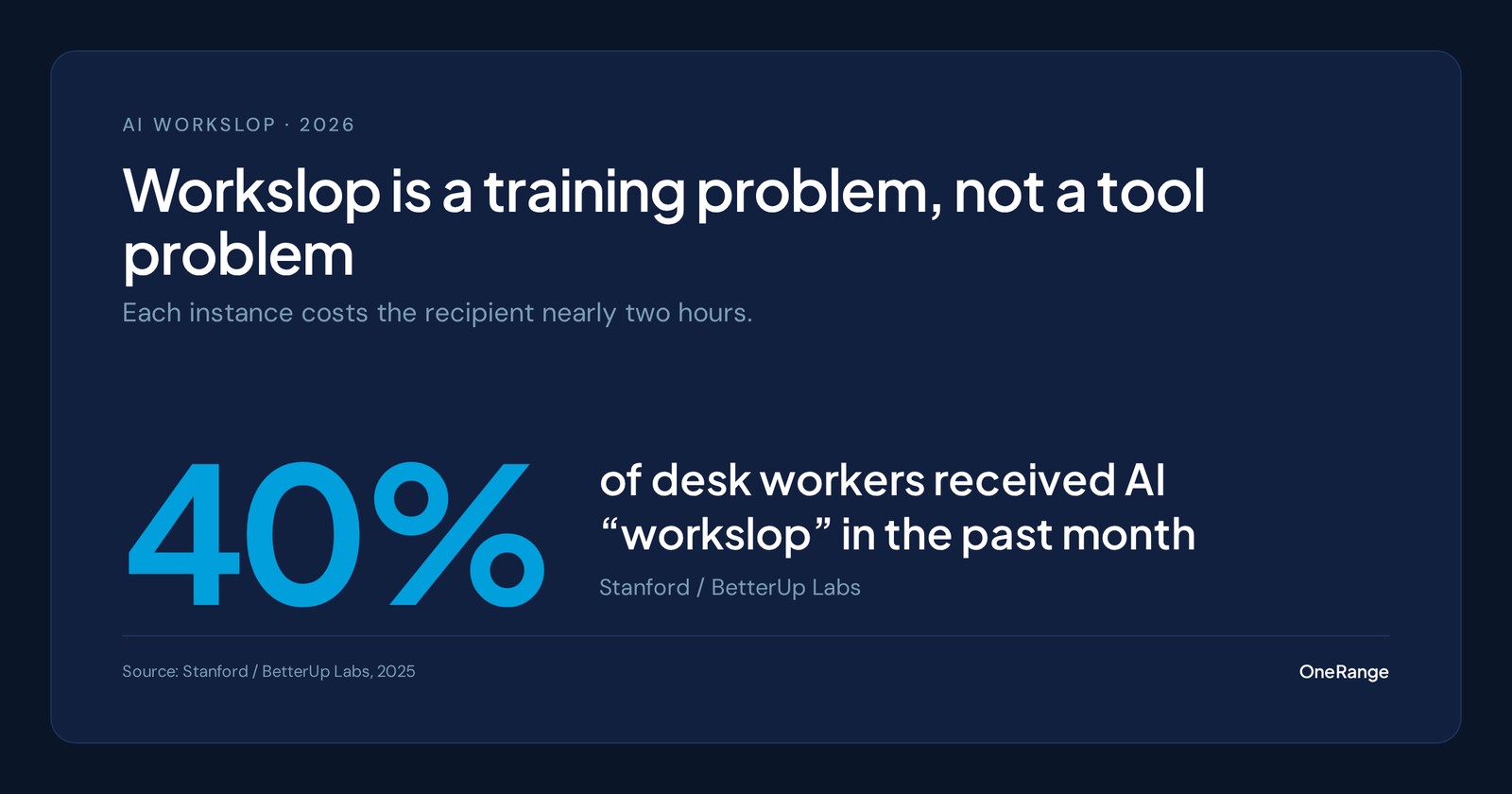
- 40% — Desk workers who received workslop in the past month (Stanford / BetterUp Labs, 2025)
- 1h 56m — Time spent dealing with each instance (Stanford / BetterUp Labs, 2025)
- $186 — Estimated cost per employee, per month (Stanford / BetterUp Labs, 2025)
- 77% — Say reviewing AI-generated work takes longer than reviewing human work (GoTo / Workplace Intelligence, 2026)
The survey of 1,150 US desk workers found that 40% had received workslop in the past month, that it made up about 15% of all the work content they received, and that each instance took an average of one hour and 56 minutes to resolve. The researchers put the cost at $186 per employee per month, or more than $9 million a year for a 10,000-person company. Most of it travels sideways: 40% comes from peers, 16% from managers.
The social cost may matter more than the hours. More than half of recipients said they were annoyed, 38% were confused, and 22% were offended. After receiving workslop, 54% saw the sender as less creative, 42% as less trustworthy, and 37% as less intelligent. Every slop grenade costs the sender some credibility with the people they work with most.
Mandates got the usage. They skipped the skill.
In a follow-up for Harvard Business Review, the same researchers asked why people produce workslop in the first place. Their answer was not laziness. It was pressure from above and below: leaders "issuing vague directives for employees to start using extremely powerful tools," teams that are overloaded, and cultures where "it doesn't feel safe to admit uncertainty or ask for help." Told to use AI, with no guidance on what good looks like, people use it on everything and ship whatever comes out.
The numbers on training back that up. A GoTo and Workplace Intelligence survey of 2,500 workers and IT leaders found 80% of employees agree that most workers lack adequate training on AI tools, and 43% admit they have used AI output even when they suspected it contained errors or fabrications. Only 44% of IT leaders said their company has an AI policy at all.
And the gap is widening. PwC's 2026 Global Workforce Hopes and Fears Survey of 49,364 workers in 48 countries found that AI use at work climbed to 64%, up ten points in a year, and daily generative AI use rose from 14% to 22%. Over the same period, the share of workers who say they have access to the learning they need fell from 59% to 51%. Among the 56% of the workforce PwC calls the "engine room" (no scarce specialist skills and little AI experience), fewer than 40% have it.
AI use is rising. Access to training is falling.
- Use AI at work, 2025: 54
- Use AI at work, 2026: 64
- Have access to needed training, 2025: 59
- Have access to needed training, 2026: 51
Share of workers, 2025 vs 2026. Source: PwC Global Workforce Hopes and Fears Survey 2026
More people using AI more often, with less help learning how. That is the recipe for workslop, and it is the default state of most companies right now.
The missing skill is judgment
The AI Fluency Framework, developed by Rick Dakan and Joseph Feller with Anthropic, breaks effective AI use into four competencies: Delegation, Description, Discernment, and Diligence. Workslop is what happens when they go missing.
| What workslop looks like | The fluency gap | What to teach |
|---|---|---|
| AI output sent on without being read | Discernment: evaluating what AI produces, how it got there, and whether the collaboration is working | How to check for accuracy, relevance, and gaps before anything leaves your hands |
| Generic, padded, off-target work | Description: giving AI the context, constraints, and definition of done it needs | How to brief a task so the first draft is worth editing |
| AI used on tasks that needed a person's thinking | Delegation: deciding what to hand to AI and what to keep | When AI is the wrong tool, and how to tell |
| Nobody says what was AI-made or who checked it | Diligence: owning the output, disclosure, and the downstream effect on colleagues | The norm that the sender, not the receiver, is responsible for quality |
Discernment is the one that most directly separates a useful AI draft from a slop grenade, and it is the one almost nobody has been taught. The framework describes it as evaluating the product (is the output accurate and fit for purpose), the process (did the AI reason its way there sensibly), and the performance (is the back-and-forth getting you somewhere). It is a learnable skill, and it is measurable. Our guide to AI fluency explains all four competencies in plain language.
This is also why usage metrics make workslop worse. If the number that matters is how many people use AI, or how often, the rational move is to run everything through it and send it on. We covered the token-leaderboard failures at Amazon and Meta in our post on AI skills in performance reviews. The same logic applies to adoption dashboards. Measure judgment, not volume.
Five things to do this quarter
- Replace "use AI" with "send good work." Keep the expectation that people use AI, but say out loud what the standard is: the sender is responsible for anything they pass on, AI-assisted or not. Shopify's own lesson is that a mandate without a quality bar produces volume
- Measure discernment, not adoption. Give everyone the same short assessment of AI fluency so you know who can evaluate AI output and who cannot. Our free AI fluency assessment covers all four competencies, including Discernment
- Teach reviewing as a skill, with real examples. The most effective training uses your own company's workslop: the padded email, the deck with the invented statistic. Have people find the problems, fix them, and write the brief that would have avoided them
- Start with the engine room. PwC's data says the largest group in your company is the one least likely to have had any training. These are also the people most likely to be told to use AI without being told how. Train them first, by role, with a shared foundation and then role-specific practice. See how to train employees on AI for the structure
- Track the receiving end. Ask teams how much time they spend reviewing or redoing colleagues' AI-assisted work, and ask again after training. Rework time, send-backs, and error rates will tell you whether workslop is shrinking. Usage counts will not
If your teams are starting to use AI agents, the stakes go up: an unreviewed draft wastes a colleague's time, while an unreviewed agent takes actions. See how to train employees on AI agents.
How OneRange Vero helps
Vero is interactive AI training. Instead of a video and a quiz, each employee works through a conversation that adapts to their answers, so they practice judging and improving AI output rather than watching someone else do it.
- Skill assessments that place each person at Beginner, Intermediate, Advanced, or Expert for each AI skill, including interpreting AI output, with strengths and areas for improvement
- Open Answer questions, graded by AI, so people are assessed on the quality of their judgment and not only on multiple-choice recall
- Ready-made AI fundamentals training that covers evaluating AI output, briefing tasks well, and knowing when not to use AI
- A custom company layer that brings your own AI policy, tools, and examples into the training
- Workforce Results for managers, so you can see which teams are ready to be trusted with AI-assisted work and which need support first
None of that will stop every slop grenade. It will make sure the people throwing them know what one looks like, and that you know who still needs help.
Sources
- Fortune, Shopify CEO says employees' 'slop grenades' are making more work for everyone else (Sep 17, 2026) — https://fortune.com/2026/09/17/shopify-tobias-lutke-ai-slop-grenades/
- Futurism, 'Slop Grenades': Shopify CEO who pushed staff to use AI is now horrified by what he's wrought (Sep 2026) — https://futurism.com/artificial-intelligence/shopify-ceo-ai-workplace-staff-horrified-backfire
- Inc., Shopify CEO to employees: use AI now (Apr 2025) — https://www.inc.com/ben-sherry/shopify-ceo-to-employees-use-ai-now/91173063
- Harvard Business Review, AI-Generated "Workslop" Is Destroying Productivity (Sep 2025) — https://hbr.org/2025/09/ai-generated-workslop-is-destroying-productivity
- Harvard Business Review, Why People Create AI "Workslop" and How to Stop It (Jan 2026) — https://hbr.org/2026/01/why-people-create-ai-workslop-and-how-to-stop-it
- Axios, AI 'workslop' sabotages productivity, study finds (Sep 2025) — https://www.axios.com/2025/09/24/ai-workslop-workplace-efficiency-study
- GoTo and Workplace Intelligence, The Pulse of Work in 2026 (2026) — https://workplaceintelligence.com/pulse-of-work-in-2026-study/
- PwC, Global Workforce Hopes and Fears Survey 2026 (Sep 2026) — https://www.pwc.com/gx/en/1/issues/workforce/hopes-and-fears.html
- AI Fluency Framework (Dakan & Feller, with Anthropic) — https://aifluencyframework.org/
Tags: AI, AI Fluency, Productivity, Learning & Development
FAQ
Frequently asked questions
What is AI workslop?
Workslop is a term coined by researchers at Stanford and BetterUp Labs for AI-generated work that looks polished but lacks the substance to move a task forward. It shifts the real work onto the person who receives it, who has to interpret, correct, or redo it.
How common is workslop?
In the Stanford and BetterUp Labs survey of 1,150 US desk workers, 40% had received workslop in the past month, and it made up about 15% of all the work content they received. Each instance took nearly two hours to deal with.
What did Shopify's CEO say about "slop grenades"?
In September 2026, Tobi Lütke said Shopify employees were tossing "slop grenades" at each other: unreviewed AI output that colleagues then have to fix. He called it "definitely a bad thing." In 2025 he had told staff that using AI effectively was a baseline expectation.
Why do employees produce workslop?
The researchers behind the term point to vague directives to use AI, overloaded teams, and cultures where it does not feel safe to admit uncertainty. Most employees were told to use AI and were never taught how to judge what it gives them.
Can an AI policy stop workslop?
A policy helps set expectations, but it does not build skill. The fix is teaching people to evaluate AI output, to describe tasks well enough to get useful results, and to know when AI is the wrong tool. Those are the Discernment, Description, and Delegation skills in the AI Fluency Framework.
How do you measure whether workslop is getting better?
Assess AI fluency before and after training, and track the receiving end of work: time spent reviewing or redoing colleagues' AI-assisted output, error rates, and how often work is sent back. Usage counts will not tell you anything about quality.
Related
- AI fluency assessment: 20 questions and a rubric — Score an employee's delegation, description, discernment, and diligence to a proficiency level.
- AI Skills Are Now in Performance Reviews. Here's How to Evaluate Them Fairly — Why usage metrics backfire, and how to evaluate AI skills fairly instead.
- OneRange Vero: interactive AI training — Interactive AI training built from your own source material and adapted to every role and level.