Workers Are Teaching Themselves AI Faster Than Employers Train Them
· 8 min read · OneRange Research
Self-taught AI rose from 22% to 30% of job seekers in a year while employer training stayed flat. Why AI training is now a recruiting and retention benefit.
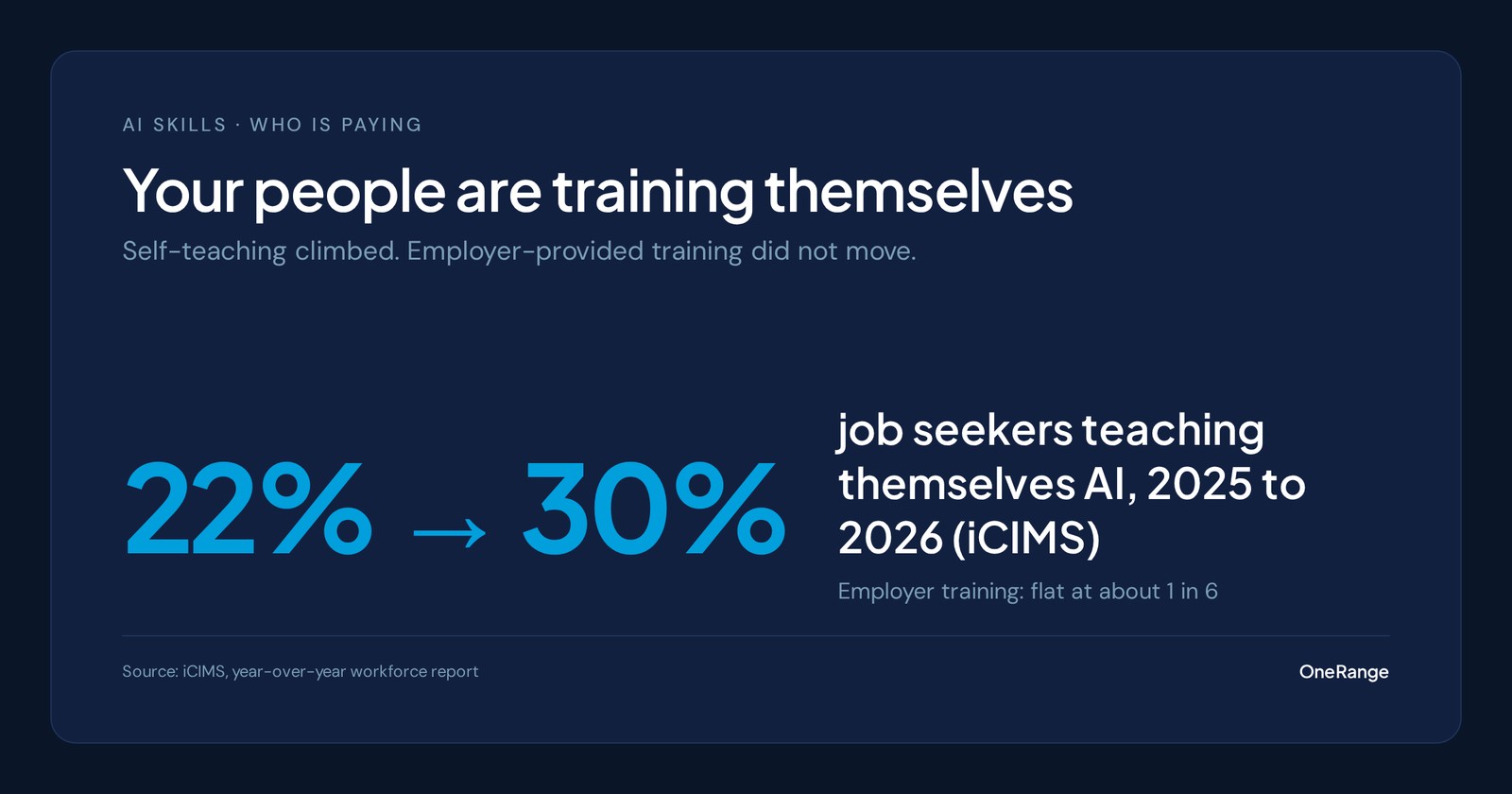
The latest iCIMS Insights report, released September 10, 2026, found 47% of US job seekers worked on their AI skills in the past six months, up from 41% a year earlier. The share teaching themselves rose from 22% to 30%. Employer-provided training stayed roughly flat at about one in six.
As iCIMS's head of talent insights, Trent Cotton, put it: "Workers are outpacing employer training. Job postings are outpacing both."
Who is building AI skills?
- Self-teaching AI, 2025: 22
- Self-teaching AI, 2026: 30
- Employer-provided training, 2026: 17
Share of US job seekers. Employer training shown as about one in six. Source: iCIMS Insights, September 2026
Your people aren't waiting for a program
The iCIMS numbers match what employees report elsewhere. In Bright Horizons' 2026 Workforce Outlook, a Harris Poll survey of 2,017 employed US adults, 42% said their employer expects them to learn AI on their own, and 34% feel unprepared. EY found 83% of desk workers are self-taught on AI.
Self-teaching is a good instinct. It also has limits. In the iCIMS data, 60% of job seekers feel ready to adapt to AI at work, but 61% describe their skills as limited to general-purpose tools like ChatGPT, Copilot, or Gemini. Only 18% report prompt engineering skills. People are learning, but mostly the basics, on their own time, with whatever they can find.
AI training is now a benefit candidates shop for
- 42% — Job seekers who find employers offering AI training more attractive (iCIMS, Sep 2026)
- 14% — Would accept lower pay in exchange for AI training (iCIMS, Sep 2026)
- 55% — Employees more likely to stay with access to AI training (Bright Horizons, 2026 Outlook)
- 85% — More loyal to an employer that invests in their education (Bright Horizons, 2026 Outlook)
That shifts AI training from an L&D line item to a talent lever. When 42% of job seekers say AI training makes an employer more attractive, it belongs in the job post and the offer letter, next to health insurance and retirement matching.
It works on the retention side too. LinkedIn's Workplace Learning Report found providing learning opportunities is organizations' number one retention strategy. And AI skills carry a market premium: Lightcast found job postings that list AI skills offer 28% higher salaries, and 51% of those postings are outside IT and computer science. Employees can see that premium. If you don't help them build the skills, a competitor will.
Training changes behavior, not just sentiment
The strongest argument for employer-supported AI training isn't that employees want it. It's what happens after they get it.
AI adoption with and without employer training
- Employer provides AI training: 76
- No employer training: 25
Share of employees using AI. Source: Bright Horizons 2026 Workforce Outlook
Bright Horizons found AI adoption is 76% where employers provide training and 25% where they don't. BCG found employees who receive five or more hours of AI training are much more likely to use AI regularly, yet only 36% of employees feel adequately trained.
The hidden cost of "figure it out yourself"
When employees learn AI on their own, they also choose their own tools. BCG found 54% of employees would use AI tools even if they weren't authorized. That is where the risk sits:
- IBM's Cost of a Data Breach 2025 found one in five breached organizations traced a breach to shadow AI, and high shadow AI use added $670,000 to the average breach cost
- Only 37% of organizations have policies to manage AI or detect shadow AI (IBM)
- Self-taught skills are uneven. Some people become power users; many stall at the basics, and nobody can see who is where
The answer isn't to stop self-directed learning. It is to give it a direction, a budget, and guardrails.
How to channel self-directed AI learning
- Fund it. Give every employee a learning budget or stipend they can spend on AI courses, workshops, and certificates. Our guide to setting the right professional development budget covers how much, and our explainer on the proposed AI training tax credit covers what it may cost after tax
- Curate it. Point that budget at a vetted set of providers and courses, so people aren't paying for random videos or putting company data into unapproved tools
- Guide it. Tie learning to each person's role and goals, and pair it with a clear AI use policy
- Track it. See what people learn and what it costs, by team and by skill, so you know whether AI capability is actually growing
- Say it out loud. Put AI training in job posts, offer letters, and your benefits page. Candidates are looking for it
How OneRange Atlas helps
Atlas is the upskilling marketplace. It turns a learning budget into a benefit employees actually use, and gives you the controls to keep AI learning on track.
- One marketplace of external learning from providers like Coursera, Udemy, Maven, Pluralsight, and more, so employees choose from approved options
- Budgets and stipends you set by person or team, with approvals and virtual cards to pay for what employees pick
- Visibility into what your people are learning and what it costs, by skill and team, including how much is going to AI
See how it works for learning stipends and training budget management.
See how Atlas turns a learning budget into AI skills you can track.
Sources
- iCIMS Insights, September 2026 Workforce Report (Sep 10, 2026) — https://www.icims.com/company/newsroom/septemberinsights2026/
- Bright Horizons, 2026 Workforce Outlook (Dec 2025) — https://investors.brighthorizons.com/news-releases/news-release-details/2026-workforce-outlook-employers-prioritize-ai-literacy-and
- EY, Agentic AI workforce survey (Oct 2025) — https://www.ey.com/en_us/newsroom/2025/10/new-ey-survey-reveals-majority-of-workers-are-enthusiastic-about-agentic-ai-but-leadership-gaps-in-communication-and-lack-of-training-threaten-impact
- BCG, AI at Work 2025 (Jun 2025) — https://www.bcg.com/press/26june2025-beyond-ai-adoption-full-potential
- LinkedIn, 2025 Workplace Learning Report — https://business.linkedin.com/learn/resources/workplace-learning-report
- Lightcast, Beyond the Buzz (Jul 2025) — https://lightcast.io/resources/blog/beyond-the-buzz-press-release-2025-07-23
- IBM, Cost of a Data Breach Report 2025 (Jul 2025) — https://newsroom.ibm.com/2025-07-30-ibm-report-13-of-organizations-reported-breaches-of-ai-models-or-applications,-97-of-which-reported-lacking-proper-ai-access-controls
Tags: AI, Learning Stipends, Retention, Learning & Development
FAQ
Frequently asked questions
Are employees teaching themselves AI?
Yes. iCIMS found the share of US job seekers teaching themselves AI rose from 22% to 30% in a year, while employer-provided training stayed flat at about one in six. Bright Horizons found 42% of employees say their employer expects them to learn AI on their own.
Does offering AI training help with recruiting?
The data says it does. In iCIMS's September 2026 survey, 42% of job seekers said a company offering AI training would be more attractive than a similar employer that did not, and 14% said they would accept lower pay in exchange for it.
Does AI training improve employee retention?
Bright Horizons found 55% of employees say access to AI training or certification would make them more likely to stay, and 85% would be more loyal to an employer that invests in continuing education. LinkedIn reports that providing learning opportunities is organizations' number one retention strategy.
Why not just let employees learn AI on their own?
Self-taught skills tend to stop at general-purpose chatbots, and self-directed use often happens in unapproved tools. IBM found one in five breached organizations traced a breach to shadow AI, adding an average of $670,000 to breach costs.
How can employers support self-directed AI learning?
Give employees a learning budget they can spend on approved AI courses and resources, pair it with a clear AI use policy, and track what people learn and spend so you can see which skills are growing.
Related
- Learning stipend software — Run a stipend program without spreadsheets, expense reports, or extra headcount.
- OneRange Atlas: the upskilling marketplace — 22,000+ learning resources, AI-matched to each employee, paid for only when they are used.
- Is There a Tax Credit for AI Training? The AI Workforce Training Act, Explained — The proposed 30% federal credit for AI training, and what it would change about budgeting.