The State of AI Training 2026: Adoption Went Vertical. Readiness Didn't.
· 11 min read · OneRange
Half of US workers use AI. Only 19% work somewhere ready for it. Ten studies on AI training in 2026 — the data, the gap, and what to fix first.
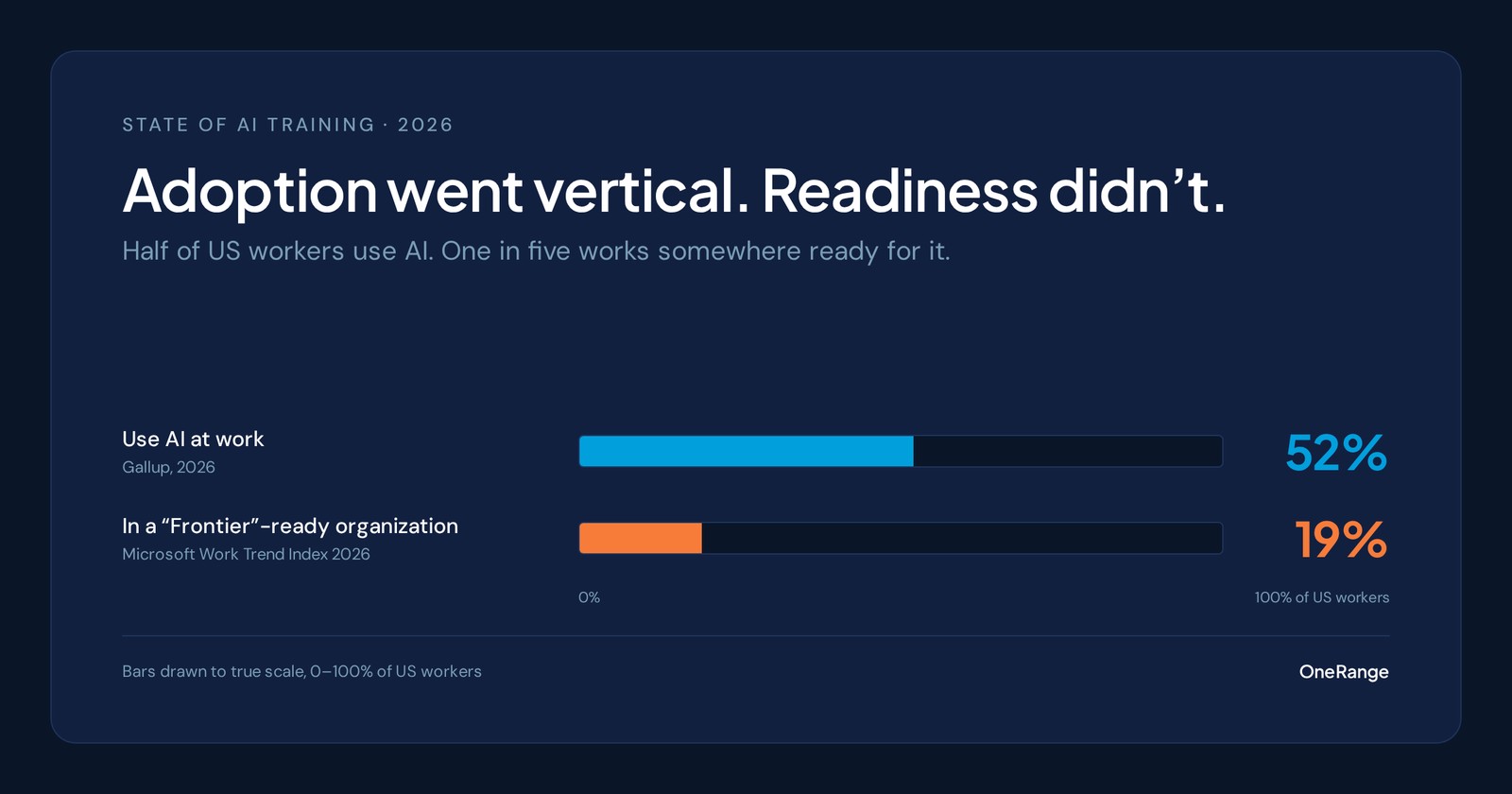
What ten major studies — from Gallup, Microsoft, the World Economic Forum, Harvard, and across the L&D industry — reveal about the state of AI training in 2026.
Every year the training industry publishes hundreds of statistics. Read enough of them side by side and something uncomfortable emerges: the numbers no longer agree with each other.
Half of US workers now use AI on the job. Employers say they're upskilling for it. L&D teams say they've adopted it. And yet only one in five workers sits inside an organization that's actually ready for AI — and the strongest scientific evidence for AI in learning points at something almost nobody in corporate training is building.
We read the major 2025–2026 research so you don't have to. Here's the state of AI training in 2026, in three findings:
- 52% of US workers now use AI at work — but only 19% work in organizations ready for it
- 87% of L&D teams use AI — mostly to make content faster, not to teach better
- The best-evidenced use of AI in learning — tutoring — roughly doubled learning gains in a randomized Harvard study. It's the use case L&D has barely touched
- 52% — of US workers use AI at work (Gallup, 2026)
- 19% — reach "Frontier" AI readiness (Microsoft Work Trend Index 2026)
- 87% — of L&D teams already use AI (Synthesia, n=421)
- 90% — report productivity gains at 7+ AI task types (Gallup breadth-of-use data)
1. The adoption surge is real — and it just accelerated
Start with the workers. According to Gallup's workplace AI tracking, 52% of US employees now use AI in their role, 30% use it a few times a week or more, and 15% use it daily. Organizational adoption jumped six points in a single quarter — to 47% — the sharpest rise Gallup has recorded since it began tracking in 2025.
The infrastructure side is moving even faster. Microsoft's 2026 Work Trend Index reports 15x year-over-year growth in active AI agents inside Microsoft 365 — 18x in large enterprises. Two-thirds of AI users say the technology lets them spend more time on high-value work, and 58% say they're producing work they couldn't have created a year ago.
Figure 1 — AI adoption at work (US)
- Any AI use: 52
- Weekly+: 30
- Daily: 15
- Org adoption: 47
Source: Gallup workplace AI tracking, 2026. Percentages of US employees and organizations.
This is no longer an adoption story. Adoption happened. The question that matters in 2026 is what happens after the licenses get distributed — and that's where the data turns.
2. The readiness gap: skills aren't keeping up with software
Microsoft's researchers segmented the workforce by two dimensions: individual AI capability and organizational support. The result is the most important single statistic in this report: only 19% of workers reach "Frontier" status — high personal skill inside an organization set up to use it. Another 10% are skilled workers stuck in unprepared organizations. The rest are somewhere between stalled and unsupported.
And here's the part that should reframe every AI skilling conversation: when Microsoft decomposed what actually drives AI impact, organizational factors — culture, manager support, talent practices — explained 67% of the outcome. Individual factors explained 32%.
In other words: AI performance is not a tool problem, and it's mostly not even an individual-talent problem. It's a training and enablement problem. If you want a structured way to see where your own organization sits, our AI readiness framework and free assessment scores exactly these dimensions.
The macro picture says the gap is about to widen. The World Economic Forum's Future of Jobs Report 2025 projects that roughly 40% of job-required skills will change by 2030, with 170 million new roles created and 92 million displaced. Of every 100 workers, 59 will need reskilling or upskilling by 2030 — and 11 of them are unlikely to get it. That's more than 120 million workers at risk of redundancy, while 63% of employers name the skills gap as their single biggest barrier to transformation.
Figure 2 — Of every 100 workers, by 2030
- Need reskilling: 59
- Won't receive it: 11
- No reskilling needed: 41
Source: World Economic Forum, Future of Jobs Report 2025.
Employers know it, at least on paper: 77% plan to upskill their workforce for AI. But intent and infrastructure are different things. Gallup finds that 20% of employees don't even know whether their employer has adopted AI at all. You cannot enable people you haven't even informed.
3. The content factory problem: L&D adopted AI backwards
So what is the training function doing with AI? Almost everything except teaching.
Synthesia's 2026 AI in L&D survey of 421 L&D professionals found 87% already using AI, with only 2% having no plans at all. Look at what they use it for, though, and a pattern appears: voice generation (63%), content and quiz drafting (60%), video creation (52%), translation (38%). The single biggest cited incentive is speed (84%), and the most common tool is not a learning platform at all — it's ChatGPT (74%).
Figure 3 — What L&D teams actually use AI for
- Speed as motive: 84
- ChatGPT as tool: 74
- Voice generation: 63
- Content/quiz drafting: 60
- Video creation: 52
- Translation: 38
Source: Synthesia AI in L&D Report 2026 (n=421). Every top use case speeds up content production; none changes how learners learn.
Every one of those use cases makes content production cheaper. None of them changes what happens when a learner actually sits down to learn. L&D has adopted AI as a content factory, not as a teacher.
Now put that next to the strongest evidence we have about AI and learning. In a randomized crossover experiment at Harvard, physics students who learned with a purpose-built AI tutor learned more than twice as much in less time than students in an actively-taught classroom — and reported higher engagement doing it. Two caveats matter, and they're instructive. First, the tutor wasn't raw ChatGPT: it was carefully engineered with pedagogical guardrails and supplied with correct solutions to prevent hallucination. Second, the effect was strongest for foundational learning. The lesson isn't "chatbots teach." It's that purpose-built AI tutoring works — and generic chat doesn't get you there. That distinction is the whole design premise behind how the Vero AI tutor works.
The gap between practice and evidence is the defining irony of AI training in 2026. Asked where AI will create the most value in the next two years, L&D leaders themselves point to personalized learning (72%), wider reach (65%), better engagement (56%), and clearer business impact (55%) — which is, almost line for line, a description of what AI tutoring delivers and content generation doesn't.
Employees, meanwhile, are voicing the cost of the current approach. In TalentLMS's 2026 L&D Report, 36% of employees said generative AI tools are weakening their problem-solving ability, and 47% of leaders admitted their AI training is built with automation of jobs in mind. Even Microsoft's most sophisticated AI users show the tell: 43% of "Frontier" professionals deliberately complete some work without AI specifically to keep their own skills sharp. The most AI-fluent people in the workforce are practicing. Most training programs don't ask anyone to.
See what role-based AI enablement looks like
4. The measurement problem: completion is not capability
There's a second structural problem underneath the first one. Even where training exists, most organizations still can't say what it produced.
The industry's own numbers make the case. Online course completion commonly hovers around 30%. Meanwhile 95% of HR managers agree better training improves retention, 79% say their company is moving to a skills-based approach, and 35% of employees say they'd leave a company that denied them training. The belief in training is nearly universal. The evidence trail mostly stops at "completed."
LinkedIn's Workplace Learning research shows how thin the connective tissue is: only 36% of organizations qualify as genuine "career development champions," just 15% of employees say their manager helped build a career plan in the past six months (down from 20% a year earlier), and 49% of L&D professionals report executives worrying that employees lack the skills to execute strategy. Executives aren't asking whether people finished the course. They're asking whether people can do the work.
Closing that gap means measuring proficiency instead of attendance — what skill assessments are for — and translating the delta into money, which our AI Training ROI Calculator does with your own headcount and salary numbers.
Gallup's data offers the sharpest picture of what closing that gap is worth. Among workers applying AI to only one or two task types, 45% report productivity gains. At three to four task types, it's 66%. At five to six, 78%. At seven or more, 90%. Same tools, same companies — the difference is breadth of enablement, which is another way of saying the difference is training. Distributing licenses produces the 45% experience. Deliberate, measured skill-building produces the 90% one.
Figure 4 — Productivity gains rise with breadth of AI use
- 1–2 tasks: 45
- 3–4 tasks: 66
- 5–6 tasks: 78
- 7+ tasks: 90
Source: Gallup, 2026. Share of workers reporting productivity gains, by number of task types they apply AI to.
5. What to do about it in 2026
The data points to a fairly specific playbook for the year ahead.
- Treat AI enablement as a training program, not a rollout. Organizational factors drive twice as much AI impact as individual ones. A license plus a lunch-and-learn produces the 45% outcome; structured practice across many workflows produces the 90% one
- Move AI from your production pipeline into your pedagogy. Generating course content faster is fine, but the doubled learning gains in the research came from AI that teaches — asks, adapts, corrects, and makes the learner do the work
- Insist on purpose-built over general-purpose. The Harvard tutor worked because it was engineered against hallucination and grounded in verified material. Three-quarters of L&D teams currently running on raw ChatGPT should read that caveat twice
- Measure proficiency, not completion. Skills-based talk (79% of companies) has outrun skills-based measurement. The organizations that can put a number on capability — skill uplift, time to competency, gap closure — are the ones whose executives stop asking whether training is worth it
- Close the loop before 2030 does it for you. Fifty-nine of every hundred workers need reskilling this decade, and on current trends eleven won't get it. The companies that outlearn other companies will outperform them
OneRange Vero was built for exactly this shift: interactive AI tutors that teach and adapt instead of playing content, grounded in your company's own knowledge, with assessments that measure proficiency — not attendance.
6. Five predictions for AI training in 2027
Extrapolating from the same data, here is where we think the next twelve months go. These are our predictions, not findings — free to quote with attribution.
- Prediction 1 — "AI-ready" becomes a measured number, not a slogan. With organizational factors explaining 67% of AI impact, boards will start asking for a readiness score by function the same way they ask for engagement scores. Expect readiness benchmarking to become a standard line in the 2027 HR reporting pack
- Prediction 2 — The content-generation boom peaks and the tutoring boom starts. Speed is already the top motive for 84% of L&D teams, and speed saturates: once everyone can generate a course in an hour, the differentiator moves to whether learners actually get better. The budget shifts from producing content to teaching with it
- Prediction 3 — Completion rates quietly stop being reported. When 79% of companies claim a skills-based approach and course completion still hovers near 30%, the metric becomes indefensible. Proficiency deltas, time to competency, and gap closure replace it in executive reporting
- Prediction 4 — Deliberate no-AI practice becomes a formal training design pattern. 43% of Microsoft's most AI-fluent workers already switch AI off to keep their own skills sharp, while 36% of employees say AI is eroding their problem solving. Expect "unassisted reps" to show up inside curricula the way spaced repetition did
- Prediction 5 — Breadth of use becomes the enablement KPI. Gallup's 45%-to-90% productivity curve across task breadth is the cleanest ROI lever in the data. Programs will be scored on how many distinct workflows an employee can apply AI to, not on how many licenses were issued
If you want to test the first prediction against your own organization, the company AI readiness assessment produces exactly that score in about ten minutes.
If the shift from content to measurement changes what you need to buy, our roundup of the best AI training platforms in 2026 breaks the market into four categories and says who each one is actually for.
Citing this report
This report and its figures are free to cite and republish with attribution. Please link back to https://onerange.ai/blog/state-of-ai-training-2026 — individual charts are linkable via their anchors (#fig-adoption, #fig-reskilling, #fig-ld-use, #fig-breadth). Suggested citation: OneRange, "The State of AI Training 2026," August 2026. For a one-page index of every figure by category, see AI training statistics 2026.
Sources
- Gallup, workplace AI tracking and AI indicator hub (Q2 2026) — https://www.gallup.com/394373/indicator-artificial-intelligence.aspx
- Gallup, AI use at work has doubled in two years — https://www.gallup.com/workplace/691643/ai-use-work-doubled-two-years.aspx
- Microsoft, 2026 Work Trend Index: agents, human agency and the opportunity for every organization — https://www.microsoft.com/en-us/worklab/work-trend-index/agents-human-agency-and-the-opportunity-for-every-organization
- World Economic Forum, Future of Jobs Report 2025 — https://www.weforum.org/press/2025/01/future-of-jobs-report-2025-78-million-new-job-opportunities-by-2030-but-urgent-upskilling-needed-to-prepare-workforces/
- Synthesia, AI in Learning and Development Report 2026 (n=421 L&D professionals, surveyed Oct–Nov 2025; sample skews enterprise and early adopter) — https://www.synthesia.io/reports/ai-in-learning-and-development-report-2026
- TalentLMS, 2026 L&D Report (n=101 HR managers + 1,000 US employees, Sept 2025) — https://www.talentlms.com/research/learning-development-report-2026
- LinkedIn, Workplace Learning Report — https://business.linkedin.com/learn/resources/workplace-learning-report
- Kestin et al., Harvard AI tutoring study (randomized crossover, n≈200), coverage — https://hechingerreport.org/proof-points-ai-tutor-harvard-physics/
- Harvard Gazette, professor tailored AI tutor to physics course, engagement doubled — https://news.harvard.edu/gazette/story/2024/09/professor-tailored-ai-tutor-to-physics-course-engagement-doubled/
- Methodology: figures are quoted as published by their original sources; where sample sizes or study limitations are material they are noted in the text
Tags: Research, AI, Learning & Development
Related
- AI training statistics for 2026 — Sourced figures on adoption, spend, skills gaps, and training outcomes.
- AI readiness: how to assess where your people stand — The dimensions to measure before you buy training, and how to baseline them.
- The Vero AI Catalog — Ready-made AI courses, skill assessments, pathways, and certifications you can assign today.