Your Employees Already Use AI Agents. Most Were Never Trained.
· 9 min read · OneRange Research
Only one in three AI users has had formal training on AI agents. What agents change about the job, the skills to teach, and a five-module training plan.
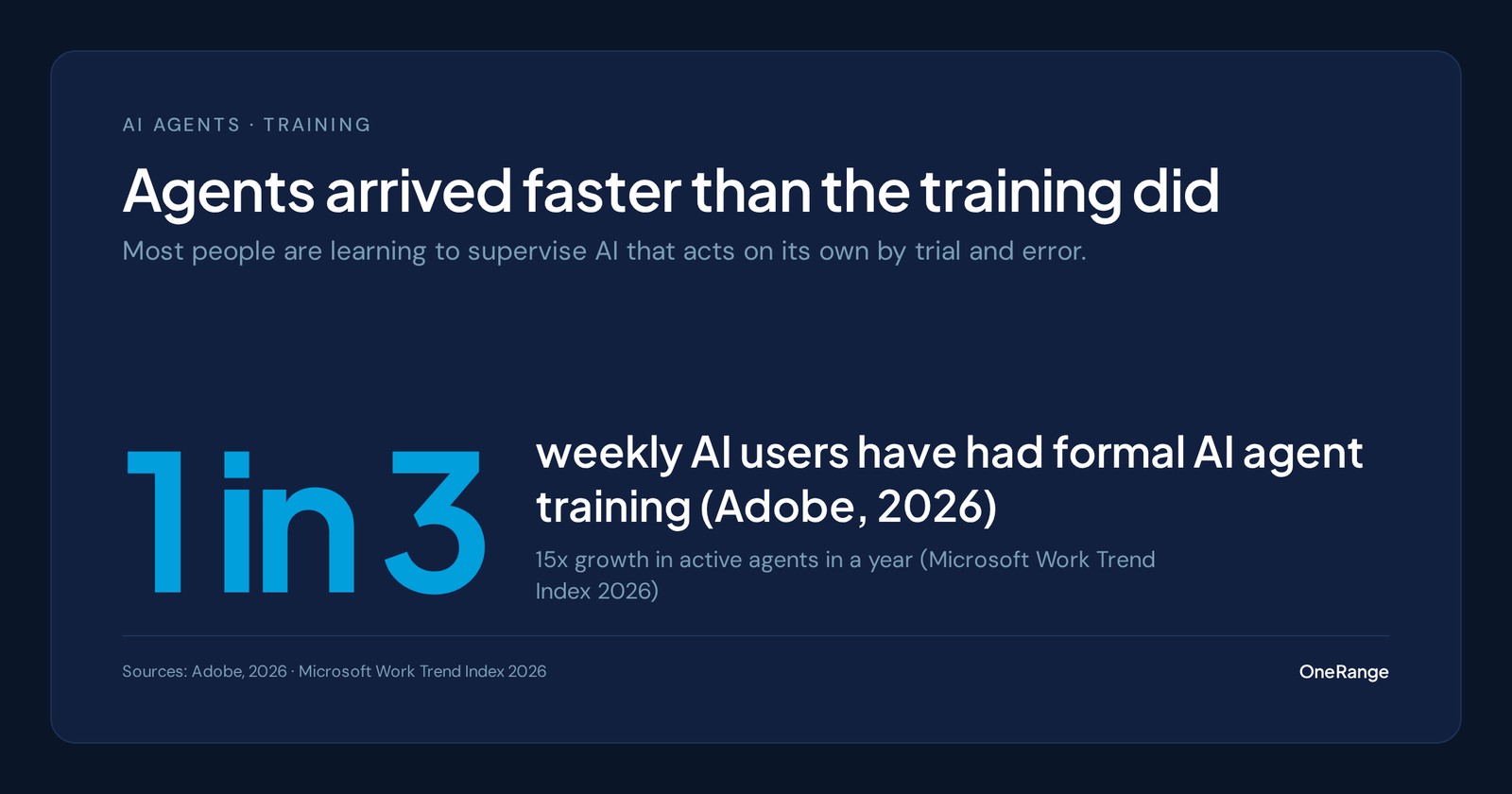
Adobe surveyed more than 1,000 US workers who use AI every week and found that only one in three has received formal training on agentic AI. The rest are learning the way most people learned ChatGPT: by trial and error (54%), YouTube (36%), and asking colleagues (25%).
That was survivable when AI only answered questions. It is riskier when AI takes actions. An agent can send the email, update the record, move the file, or run the code. A badly briefed agent doesn't give you a bad answer to ignore. It does the wrong work, at speed, with your access.
Agents are already at work
- 15x — Growth in active agents, year over year (Microsoft Work Trend Index 2026)
- 68% — Knowledge workers using AI agents (Okta, AI Agents at Work 2026)
- 1 in 3 — Weekly AI users with formal agent training (Adobe for Business, 2026)
- 83% — Desk workers who are self-taught on AI (EY, 2025)
Microsoft's 2026 Work Trend Index, a survey of 20,000 knowledge workers, found active agents grew 15x in a year, and 18x in large enterprises. Okta found 68% of knowledge workers already use AI agents. EY found 84% of US desk workers are eager to use agentic AI, but 59% say a lack of adequate training is holding them back.
What changes when AI can act
Anthropic draws a useful line: workflows follow predefined steps, while agents "dynamically direct their own processes and tool usage." That flexibility is the point, and it is also where the risk comes from. Anthropic warns of higher costs and "the potential for compounding errors" and recommends guardrails and human checkpoints.
| Chat assistant | AI agent | |
|---|---|---|
| What you give it | A question or a prompt | A goal, tools, and access |
| What it does | Returns text for you to use | Plans and takes steps on its own |
| Where mistakes land | In a draft you can ignore | In your systems, inbox, or customer records |
| The key skill | Asking well | Delegating well and supervising the work |
| Main risks | Wrong or made-up answers | Wrong actions, too much access, prompt injection, data exposure |
Workers already sense this. In Microsoft's research, the skill people rank most important for working with AI is quality control of AI output (50%), ahead of critical thinking (46%). Yet only 26% say their leadership is clearly and consistently aligned on AI.
Untrained agent use is a security problem
Okta's AI Agents at Work 2026 report shows how quickly the gaps add up:
- 52% of workers use AI tools their company hasn't approved. Of those, 45% have shared HR information and more than 20% have shared login credentials
- Only 34% of organizations apply the same security controls to agents that they apply to employees
- 58% had an AI-related security issue or close call in the past 12 months
- 65% of executives say their AI policies are very clear. Only 43% of workers agree
The AI policy perception gap
- Executives: 65
- Workers: 43
Share who say their company's AI policies are very clear. Source: Okta, AI Agents at Work 2026
Agents add a risk that chat training rarely mentions: indirect prompt injection. OWASP ranks it the top risk for AI applications. An agent reading a web page, email, or document can pick up hidden instructions planted there and act on them. Employees who grant agents access need to know this exists, which tasks it matters for, and when to keep a human approval step in place.
The skills to teach: the 4D framework, applied to agents
The AI Fluency Framework, developed by Rick Dakan and Joseph Feller with Anthropic, defines four competencies: Delegation, Description, Discernment, and Diligence. It was written for all AI use, and it maps closely to agents. The agent examples below are our application of it.
| Competency | What it means with agents |
|---|---|
| Delegation | Deciding which tasks to hand to an agent, how much autonomy to give, and which steps stay with a person |
| Description | Writing the brief: the goal, the limits, the tools and data allowed, and what done looks like |
| Discernment | Checking the result and the steps the agent took, and spotting where it went off course |
| Diligence | Owning the outcome: least-privilege access, approved tools, disclosure, and human sign-off on anything consequential |
If you want to see where your people stand on these four today, our AI fluency assessment measures each one, and the AI fluency guide explains them in more depth.
A five-module AI agent training plan
- What agents are and aren't. How agents differ from chat, what they can reach in your environment, and which agent tools your company has approved. Short, shared by everyone
- Delegating and briefing. Choosing good agent tasks, breaking work into steps, and writing briefs with limits and a clear definition of done. Practised on each team's real workflows
- Access and permissions. Least privilege, what data never goes to an agent, and how your identity and approval rules apply to agents. Built with IT and security
- Reviewing agent work. Checking outputs and the agent's trail of actions, spotting compounding errors, and knowing when to stop and escalate
- Security and oversight. Prompt injection, suspicious instructions in content, human-in-the-loop checkpoints, and how to report a problem
Two principles make it stick. Train by role: a sales rep delegating account research needs different practice from a finance analyst reconciling data. And make it hands-on: people learn to supervise agents by supervising agents, with feedback, not by watching a video about it.
Managers need their own layer. EY found 53% of people managers are concerned about supervising AI-augmented teams, and Microsoft found trust in agentic AI is 30 points higher when managers model AI use themselves. If AI use is heading into your review cycle, see how to evaluate AI skills in performance reviews.
Why this matters now
Gartner predicts that more than 40% of agentic AI projects will be canceled by the end of 2027 because of escalating costs, unclear business value, or inadequate risk controls. Deloitte found only 21% of organizations have a mature governance model for agentic AI. Better-trained users won't fix every one of those problems, but untrained users make all three worse.
How OneRange Vero helps
Vero is interactive AI training. Each employee works through a conversation that adapts to their answers, so they practice delegating to and reviewing AI in scenarios from their own role, not a generic demo.
- Ready-made AI agents training covering what agents are, how to delegate to them, and how to supervise their work
- Skill assessments that place each person at Beginner, Intermediate, Advanced, or Expert, so you know who is ready for agents before you roll them out
- A custom company layer that brings your own AI policy, approved tools, and workflows into the training
New to AI training overall? Start with our guide on how to train employees on AI.
Sources
- Adobe for Business, Agentic AI at Work (Jul 14, 2026) — https://business.adobe.com/blog/agentic-ai-at-work
- Employee Benefit News, More employees are using agentic AI, but lack training (Sep 2, 2026) — https://www.benefitnews.com/news/more-employees-are-using-agentic-ai-but-lack-training
- Microsoft, 2026 Work Trend Index (May 2026) — https://www.microsoft.com/en-us/worklab/work-trend-index/agents-human-agency-and-the-opportunity-for-every-organization
- EY, Agentic AI workforce survey (Oct 2025) — https://www.ey.com/en_us/newsroom/2025/10/new-ey-survey-reveals-majority-of-workers-are-enthusiastic-about-agentic-ai-but-leadership-gaps-in-communication-and-lack-of-training-threaten-impact
- Okta, AI Agents at Work 2026 (Mar 2026) — https://www.okta.com/newsroom/articles/ai-agents-at-work-2026-agentic-enterprise-security/
- Gartner, Over 40% of agentic AI projects will be canceled by end of 2027 (Jun 2025) — https://www.gartner.com/en/newsroom/press-releases/2025-06-25-gartner-predicts-over-40-percent-of-agentic-ai-projects-will-be-canceled-by-end-of-2027
- Deloitte, State of AI in the Enterprise 2026 (Apr 2026) — https://www.deloitte.com/us/en/insights/topics/emerging-technologies/ai-agents-scaling-faster.html
- Anthropic, Building effective agents — https://www.anthropic.com/engineering/building-effective-agents
- OWASP, LLM01: Prompt Injection — https://genai.owasp.org/llmrisk/llm01-prompt-injection/
- AI Fluency Framework (Dakan & Feller, with Anthropic) — https://aifluencyframework.org/
Tags: AI, AI Agents, AI Fluency, Learning & Development
FAQ
Frequently asked questions
What is the difference between an AI agent and a chatbot?
A chatbot answers your questions and waits for the next prompt. An AI agent is given a goal and plans and carries out multi-step work on its own, using tools and data such as your email, files, browser, or business systems. That autonomy is why agents need different training.
Do employees need separate training for AI agents?
Yes. Adobe found only one in three weekly AI users has received formal agentic AI training, and EY found 83% of desk workers are self-taught on AI. Prompting courses rarely cover delegation, permissions, reviewing an agent's work, or security risks such as prompt injection.
What should AI agent training cover?
Deciding what to delegate, writing a clear task brief with limits and a definition of done, granting the least access an agent needs, checking both the output and the steps the agent took, knowing when a human must approve an action, and handling data and prompt-injection risks.
Who should own AI agent training, L&D or IT?
Both. L&D owns the skills and behaviors. IT and security own permissions, identity, and approved tools. Okta found 65% of executives call their AI policies very clear but only 43% of workers agree, so the two teams need to train on policy together.
How do you measure whether agent training worked?
Assess skills before and after training, then track how often agent output passes review, the share of agent use happening in approved tools, and time saved on the specific workflows you targeted.
Why do so many AI agent projects fail?
Gartner predicts over 40% of agentic AI projects will be canceled by the end of 2027 due to escalating costs, unclear business value, or inadequate risk controls. Untrained users make all three worse.
Related
- AI agents training for teams — Ready-to-assign courses on delegating to agents, reviewing their work, and keeping a human accountable.
- AI fluency assessment: 20 questions and a rubric — Score an employee's delegation, description, discernment, and diligence to a proficiency level.
- OneRange Vero: interactive AI training — Interactive AI training built from your own source material and adapted to every role and level.