How to Train Your Workforce on AI Without Overwhelming Them
· 6 min read · Steve Gilman, OneRange
AI training fails when it's an all-at-once firehose. Here's a practical, role-based approach to building AI skills across your workforce—without the overwhelm.
Most AI training programs don't fail because employees can't learn. They fail because leaders try to teach everything to everyone at once. The result is predictable: glazed eyes in an all-day workshop, a certificate nobody remembers earning, and a workforce that quietly goes back to doing things the old way.
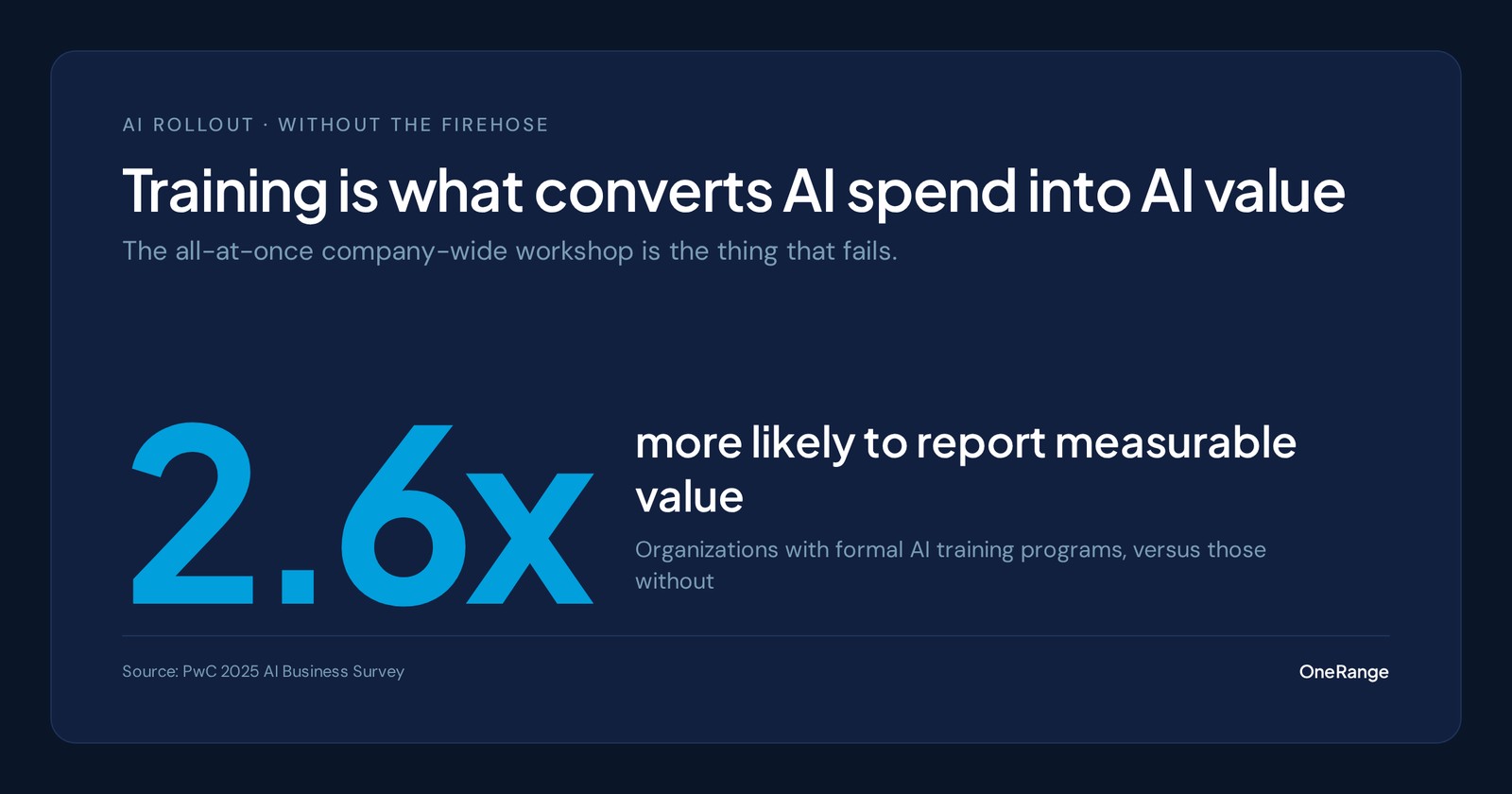
The stakes are real. According to PwC's 2025 AI Business Survey, organizations with formal AI training programs are 2.6x more likely to report measurable business value from their AI investments. And Gartner has found companies see roughly a $3.70 return for every dollar spent on employee AI training. The problem isn't whether to train—it's how to do it without burning people out.
Here are seven principles that separate AI training that sticks from AI training that stalls.
1. Start with why, not with tools
Only about half of employees say leadership has communicated a clear AI strategy—and without one, uncertainty fills the gap. A Gallup survey found that 22% of workers worry AI will replace their roles. If your first move is a mandatory ChatGPT tutorial, you're answering a question nobody asked while ignoring the one everyone's thinking.
Before any training launches, leaders should say plainly: why the company is investing in AI, what will and won't change about people's roles, and how AI is meant to support employees rather than replace them. That reassurance is the foundation. Everything else is built on it.
2. Segment by role—one size fits nobody
A finance analyst, a warehouse supervisor, and a marketing manager don't need the same AI training. Trying to serve them all with one generic course guarantees it's too basic for some and too abstract for others—the fastest route to overwhelm.
Structure your program in tiers instead:
- Foundational AI literacy for everyone: what AI can and can't do, basic prompting, and where it fits in daily work.
- Role-specific application tracks: concrete use cases mapped to each function's actual tasks.
- Advanced tracks for power users: deeper skills for the people who'll push the tools furthest.
Tiering lets you scale training across the whole organization without dragging less technical employees into material they don't need.
3. Trade the all-day workshop for microlearning
Marathon training sessions are disruptive and largely ineffective—nobody retains eight hours of material from a single sitting. Short, practical lessons that employees can apply immediately work better: five-minute tutorials, quick how-to guides, and hands-on practice woven into regular tasks.
The pattern that works: learn a small thing, use it the same day, come back for the next small thing. Momentum beats volume.
4. Train in the flow of work, not away from it
Pulling teams offline for training creates a hidden cost—the backlog waiting when they return—which makes training itself feel like a burden. The alternative is to anchor learning to real work: have employees bring an actual task (a report, an email, an analysis) and use AI on it during the session. When the training output is work they needed to do anyway, adoption stops feeling like extra homework.
5. Build champions, then let peers teach peers
Employees trust their managers and teammates more than an outside instructor. Equip a small group of enthusiastic early adopters first—people from different departments, not just IT—and let them guide their colleagues. Peer-to-peer learning sticks better, spreads faster, and gives every team a nearby human to ask the "dumb questions" people won't raise in a formal session.
6. Set guardrails so people can move fast safely
Ironically, the absence of rules creates more anxiety than the presence of them. When employees don't know what's allowed, they either avoid AI entirely or use unauthorized tools in the shadows—both bad outcomes.
A simple AI acceptable use policy removes the guesswork. It should cover:
- Which tools are approved, and for what kinds of data
- What information must never go into public AI tools
- How AI use maps to your compliance obligations
- Who to ask when something's unclear
Keep it to a page. A policy nobody reads protects nobody.
7. Make it continuous—and measure confidence, not completions
AI tools change monthly, so a one-and-done training event has a short shelf life. Give employees an always-available knowledge hub they can return to, refresh materials regularly, and gather feedback through a dedicated channel so you can adapt the program as needs shift.
And measure the right thing. Course completion rates tell you people clicked through slides. What actually predicts adoption is whether employees feel confident using AI on real tasks—research consistently shows that hands-on practice time and coaching drive usage far more than passive content does. Track skill signal, not seat time.
The overwhelm problem is a design problem
Employees aren't overwhelmed because AI is too hard. They're overwhelmed when training is generic, front-loaded, disconnected from their work, and silent on the questions that matter to them. Fix the design—clear purpose, role-based paths, small doses, real tasks, safe guardrails, continuous support—and the overwhelm disappears. What's left is a workforce that treats AI as a skill they own, not a mandate they endure.
How OneRange helps: OneRange gives every employee a personal learning budget and access to the courses, coaching, and resources that fit their role and goals—so AI upskilling is self-directed instead of one-size-fits-all. And with Vero, OneRange's interactive AI training, teams practice on adaptive scenarios grounded in your organization's own source material, producing measurable skill signal instead of completion certificates.
Ready to upskill your workforce without the overwhelm?
Tags: AI, Learning & Development, Leadership
FAQ
Frequently asked questions
How long should AI training for employees take?
Shorter and more frequent beats longer and rarer. Aim for 15–30 minute sessions employees can apply the same day, sustained over weeks—research shows employees who get several hours of cumulative hands-on practice and coaching use AI dramatically more than those who sit through a single event.
Should every employee get the same AI training?
No. Give everyone a shared foundation in AI literacy, then branch into role-specific tracks. A universal course is either too basic or too advanced for most of the audience, which drives disengagement.
How do you measure whether AI training is working?
Look past completion rates. Track whether employees are actually using AI in their workflows, how confident they report feeling, time saved on routine tasks, and quality of output. Confidence and usage are leading indicators; productivity gains follow.
What's the biggest mistake companies make with AI training?
Rolling it out to the entire company at once with no strategy communication. It overwhelms employees, invites resistance, and typically stalls before delivering results. Start small, prove value with early champions, then expand.
Related
- What AI fluency actually means — The working definition, the four capability bands, and how to measure fluency across a workforce.
- OneRange Vero: interactive AI training — Interactive AI training built from your own source material and adapted to every role and level.
- AI fundamentals training for every employee — Twenty-one ready-to-assign courses that take a workforce from a first conversation with AI to safe, productive daily use.
- best AI training platforms — An honest comparison of the platforms buying teams shortlist, and who each one actually fits.