The AI Skills Gap Is a Training Problem, Not a Technology Problem
· 14 min read · OneRange Research
90% of enterprises will face critical AI skills shortages by 2026, yet 82% already offer some form of AI training. A long read on why the gap persists — and what actually closes it
Every CEO we talk to has the same complaint, almost word for word: "We've bought the AI tools. Why isn't anything changing?" Licenses are deployed, Copilot sits in the corner of the spreadsheet, ChatGPT Enterprise is on the laptop, and the productivity dashboards barely twitch. The instinct is to blame the technology — wrong model, wrong vendor, wrong integration — or to blame the workforce for being slow to adopt. Both are wrong. The data, increasingly hard to ignore, says the gap between what AI can do and what your people actually get out of it is a training problem. And almost every organization is solving it the wrong way.
The numbers are stark. IDC projects that 90% of enterprises will face critical AI skills shortages by 2026, and pegs the global cost at $5.5 trillion in unrealized productivity. McKinsey reports that 88% of organizations now use AI in at least one business function, but only 1% have reached what researchers call "AI maturity" — the point where AI is systematically embedded across workflows. The World Economic Forum's Future of Jobs Report 2025 estimates that 59% of the global workforce will need reskilling or upskilling by 2030, and that 39% of core job skills will change in the same window. Deloitte found that 65% of organizations have abandoned AI projects specifically because of skills gaps. These are not warning signs about the future. They are the present tense.
The Training Paradox
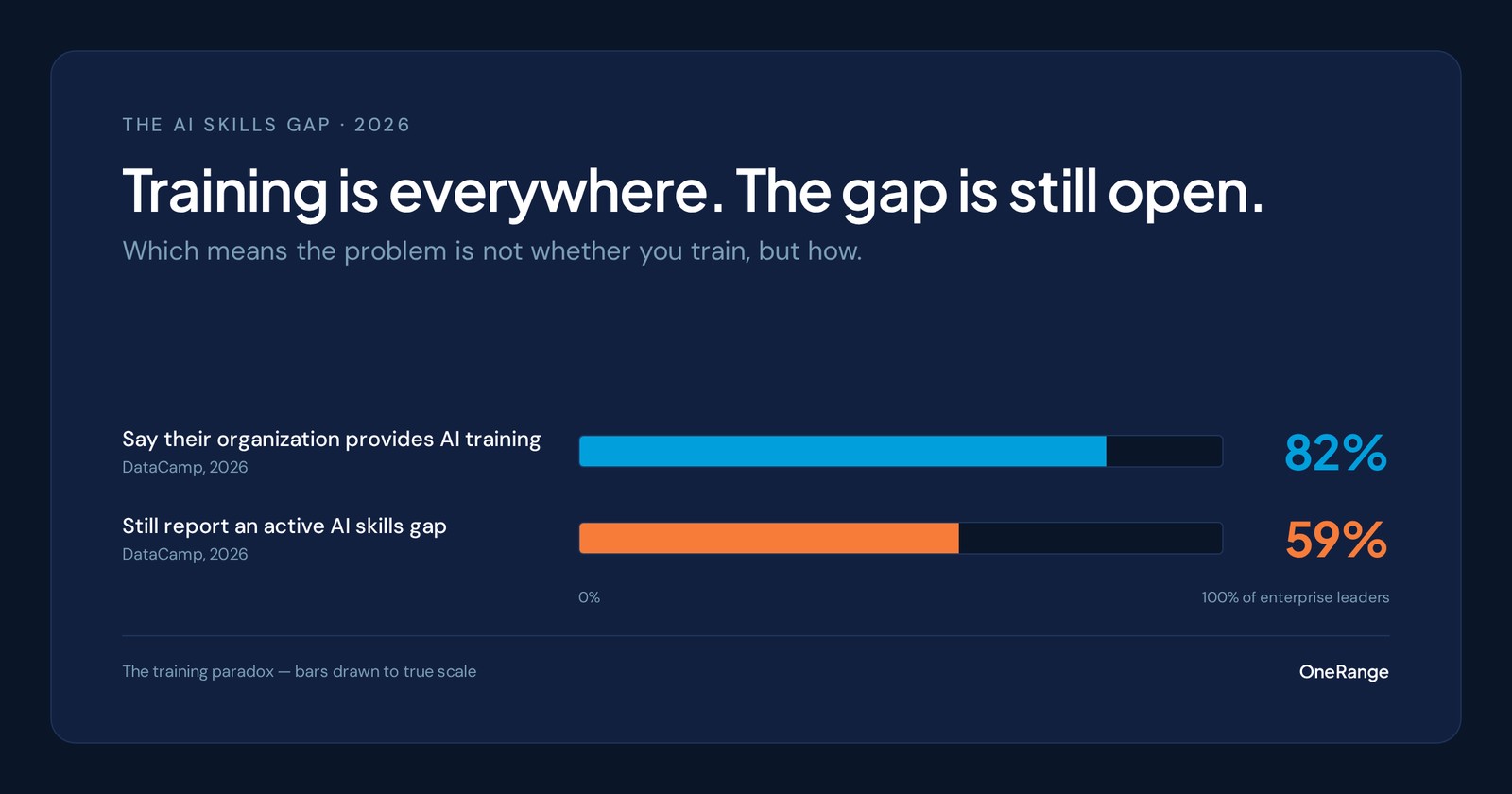
Here is the finding that should keep every Chief People Officer awake at night. According to a 2026 DataCamp study, 82% of enterprise leaders say their organization provides some form of AI training. And yet 59% still report an active AI skills gap. If training is everywhere, why isn't it working?
Because most of it isn't training. It's content. A library of LinkedIn Learning videos, an optional lunch-and-learn, a 45-minute compliance module that ends with a five-question quiz. IDC reports that only 35% of leaders have a mature, organization-wide AI upskilling program. The rest are running what amounts to a self-serve buffet — and then expressing surprise when the workforce doesn't transform itself in their spare time. Deloitte put it plainly in its 2026 State of AI in the Enterprise: "Insufficient worker skills rank as the top obstacle to integrating AI into existing workflows — not technology limitations, budget constraints, or leadership skepticism."
Why the Old Playbook Fails
Corporate L&D was built for a world where skills had a 5–10 year half-life. You hired someone who could run an Excel model, and that skill earned its keep for a decade. AI has compressed that timeline from years to months. The prompt patterns that worked on GPT-4 are already suboptimal on the current generation. A vendor's "Intro to Copilot" course shipped in Q1 is materially out of date by Q4. Workers who need reskilling have jumped from 6% of the workforce a few years ago to 35% today, and the curriculum-development cycle hasn't moved.
Compounding that, leaders fall into what we call the intuitive-interface trap. Because AI tools talk back in plain English, executives assume no one needs to be taught how to use them. The research disagrees, loudly. Trained employees achieve 2.7× higher AI proficiency and 4.1× higher satisfaction than self-taught users. Prompt engineering, output evaluation, and workflow integration are genuine skills. "It's just like Google" is the most expensive sentence in enterprise AI.
Then there's the org-design problem. IT buys the tools. L&D, if it's involved at all, gets pulled in after rollout to bolt on training. Business units are handed both and told to figure it out. IDC found that 40% of IT leaders struggle with fragmented, inconsistent skills development across their organizations. The result is the pattern every operator recognizes: powerful licenses, dormant seats, and a long tail of frustrated power-users who learned it on their own and now resent everyone who didn't.
The Cost of Doing Nothing
The economic case for closing the gap is not subtle. Microsoft-IDC's 2025 research found that structured AI training delivers $3.70 in return for every dollar invested on average, and $10.30 for top performers. Trained employees save an average of 11.4 hours per week — roughly 570 hours per employee per year, worth about $8,700 in efficiency. Multiply by a thousand-person organization and you're looking at $8.7 million in annual value, sitting on the table, because nobody built a real curriculum.
BCG's research is even more direct: organizations they classify as "AI Leaders" — the ones with formal, structured training programs — achieve 2.3× faster AI adoption and 67% higher AI ROI than their peers. BCG also famously argues that 70% of AI success comes from people, process, and change management, not algorithms or infrastructure. The 10–20–70 rule. Most companies are still spending in the opposite ratio.
And the people side is moving without you. PwC's AI Jobs Barometer puts the wage premium for workers with advanced AI skills at 56%. Second Talent Research finds 1.6 million open AI-related positions globally against just 518,000 qualified candidates — a 3.2:1 demand-to-supply ratio. Gartner projects that 80% of the engineering workforce will need AI upskilling by 2027. Your best people will either be trained by you or recruited by someone who will.
Who Is Actually Being Trained
The distribution of AI training inside the average enterprise is, to be blunt, unjust and strategically incoherent. Accenture's research shows that only 26% of workers have received any training on how to collaborate with AI. The split inside that 26% is worse: just 20% of Baby Boomers have been offered AI training, versus 50% of Gen Z. Women hold only 28% of AI positions despite being 51% of the workforce. The training that does exist is being concentrated on the youngest, most technically inclined employees — exactly the cohort that needs it least — while the senior operators who actually run the business are left to figure it out on their own.
And the appetite is there. TalentLMS's 2026 survey found that four in five employees want to learn how to use AI in their profession. The supply of motivation is not the constraint. The constraint is a design choice.
What Closing the Gap Actually Looks Like
Across the research — IDC, BCG, McKinsey, WEF, Deloitte — the organizations that close the gap have a recognizable pattern. It is not about buying a bigger LMS or licensing a fancier model. It looks like this:
- They baseline before they train. Only 23% of enterprises can accurately measure AI ROI. The leaders measure tool adoption, employee comfort, and workflow productivity before launching anything, so they can prove what changed
- They sequence by impact, not by enthusiasm. The highest-leverage roles — sales, customer service, marketing, operations — go first, because that's where 40% time savings show up almost immediately
- They make training hands-on and structured, not self-serve. Organizations with structured programs see 3–4× higher adoption. Watching a video is not training. Practicing on a real task with feedback is
- They embed learning into the actual job. Digital training is 93.7% more effective when applied to real workflows. Hypothetical case studies do not transfer; using AI to draft this week's QBR does
- They build a champions network. Peer learning, not centralized broadcast, is what scales. Every department needs a power user whose job partly is to make their colleagues better
- They take governance and evaluation seriously. Gartner predicts 50% of organizations will require "AI-free" skill assessments by 2026 to combat critical-thinking atrophy. Knowing when not to trust the model is a core skill, not an advanced one
- They measure outcomes, not completions. Course-completion rates are vanity metrics. Time saved, errors reduced, deals closed, tickets resolved — those are training metrics
The Industry-Specific Stakes
The gap doesn't show up identically across sectors, and the strategic risk is different in each. In financial services, the average time-to-fill for an AI role is 6–7 months and the demand is concentrated in governance, fraud, and compliance automation — the exact areas where mistakes are most expensive. In healthcare, the gap collides with HIPAA and FDA constraints; clinical AI demands both deep domain expertise and AI fluency, and that combination is brutally scarce. Manufacturing will need to reskill an estimated 2 million workers by 2026 as predictive maintenance and quality-control AI move from pilot to production. In cybersecurity, the SANS/GIAC 2026 report found that for the first time, skills gaps overtook headcount as the top workforce challenge — and 27% of organizations have suffered breaches directly attributable to workforce capability gaps. Professional services firms are watching AI-skilled consultants and lawyers command a 67% salary premium with 38% year-over-year growth.
What's common across all of them: the companies that win are not the ones with the most licenses. They are the ones whose people know what to do with them.
Why This Is Different From Past Tech Transitions
It's tempting to file this under "every generation of new technology causes a skills panic" — the same things were said about PCs, the internet, mobile, and cloud. The difference this time is the slope. PC adoption gave organizations a decade to retrain. Cloud gave them five years. Generative AI is on a six-to-twelve-month capability cycle. The model you train people on this quarter has materially different strengths next quarter. That doesn't mean training is impossible. It means training has to be continuous, embedded, and measured, rather than a one-time event you bill to a fiscal year.
It also means the half-life of generic content is shrinking. A pre-recorded "Intro to Prompting" course is a depreciating asset. What holds its value is the ability to teach an employee, in the context of their actual work this week, how to get more out of the tool that just changed under them. That is a fundamentally different product than the LMS most enterprises bought ten years ago.
The Honest Recommendation
If you take one thing from the research, take this: the AI skills gap will not close on its own, and it will not close because you bought more licenses. It will close because someone in your organization decided to treat workforce capability as a system — with a baseline, a structured program, hands-on practice tied to real work, governance built in, and outcomes measured in business terms rather than completion rates. The companies doing this are already pulling ahead on the 2.3× adoption and 67% ROI curves BCG documents. The companies treating training as a nice-to-have are accumulating the $5.5 trillion in unrealized productivity IDC is talking about.
The good news, if you want to call it that, is that the workforce is willing. Four in five employees want this. The constraint is not them. It is whether leadership treats AI fluency as a strategic competency on par with financial literacy or operational excellence, or as a perk in the L&D catalog. The organizations that pick the first answer are about to be very hard to compete with.
Research sources
All statistics cited in this article are drawn from Iternal AI's research compilation, "AI Skills Gap 2026: Statistics, Causes & How to Close It," available at https://iternal.ai/ai-skills-gap. Underlying sources include IDC, McKinsey, the World Economic Forum Future of Jobs Report 2025, Deloitte State of AI in the Enterprise 2026, Boston Consulting Group, DataCamp 2026, Microsoft-IDC 2025, Accenture, Gartner, PwC AI Jobs Barometer, Second Talent Research, Josh Bersin Research, TalentLMS 2026, and the SANS/GIAC 2026 Cybersecurity Workforce Report. Credit for the synthesis and framing of these statistics goes to the Iternal AI research team.
Tags: AI, Workforce, Learning & Development, Thought Leadership
Related
- What AI fluency actually means — The working definition, the four capability bands, and how to measure fluency across a workforce.
- OneRange Vero: interactive AI training — Interactive AI training built from your own source material and adapted to every role and level.
- AI training for managers and leaders — Twenty-one courses on use cases, pilots, policy, change, measurement, and running an AI programme.