Why AI-Driven Skill Assessment Beats the Multiple-Choice Quiz
· 9 min read · OneRange Team
Multiple-choice quizzes measure recognition, not capability. How conversational AI assessment evaluates what employees can actually do — and how to pilot it
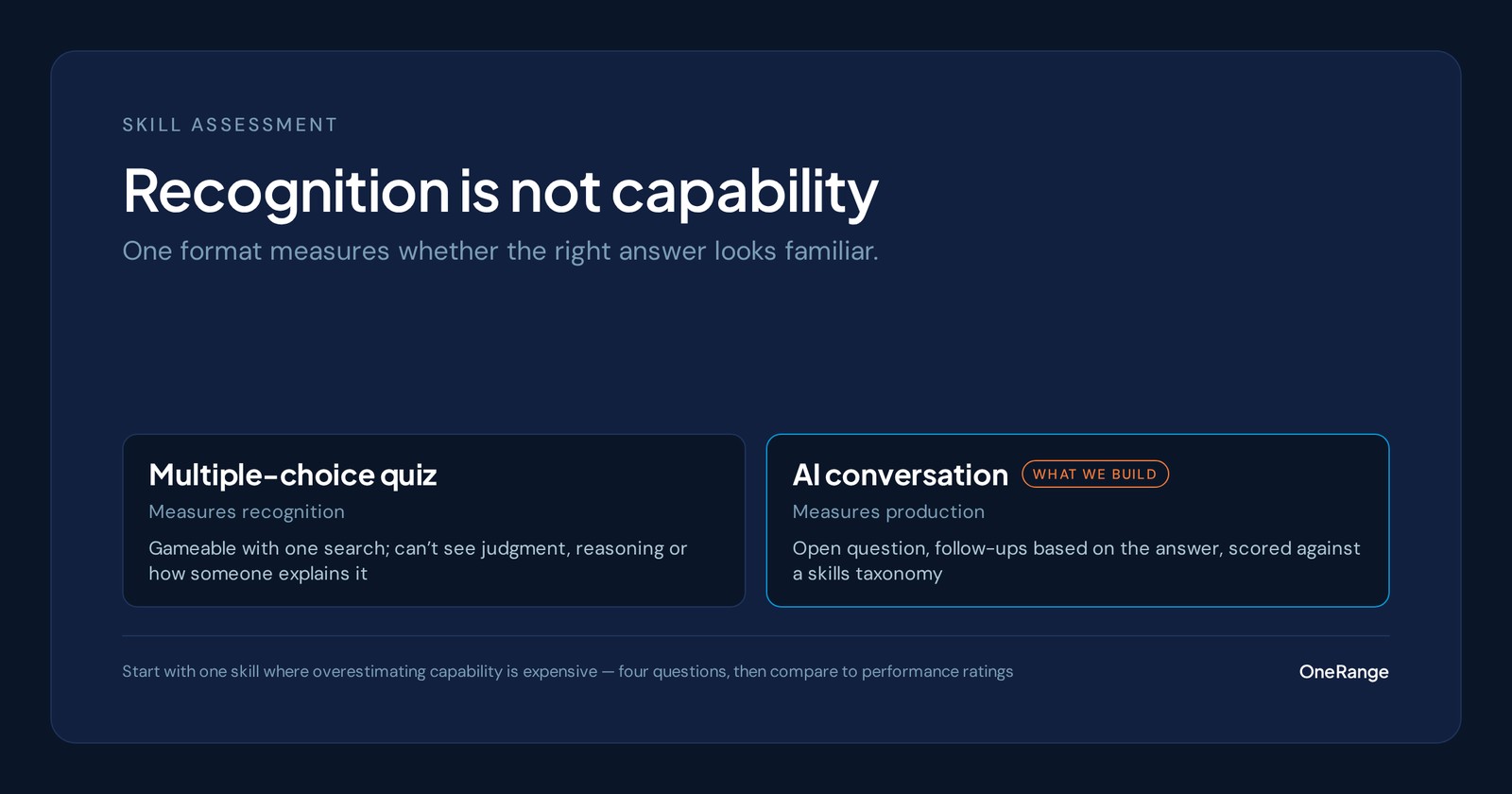
If you've ever finished a corporate training quiz and immediately forgotten which answer was C, you've experienced the core problem with multiple-choice assessment: it measures whether someone can recognize the right answer, not whether they can produce it under real conditions.
That distinction sounds academic until you try to use the score for something. Then it becomes the whole problem.
What is AI-driven skill assessment?
AI-driven skill assessment evaluates capability through open-ended conversation rather than fixed-choice questions. The learner is asked to explain, decide, or work through a scenario; the system evaluates the substance of the response, asks follow-up questions based on what was actually said, and produces a proficiency signal against a defined skill.
The mechanical difference is that nothing is pre-selected. There is no list to recognize the right answer from — the learner has to generate it, which is the same thing their job asks of them.
What multiple-choice gets wrong
It rewards test-taking strategy, not capability. Eliminate two implausible options, pick the longest remaining one, move on. Every experienced test-taker knows the heuristics, and none of them involve the skill being tested.
It can't measure judgment, reasoning, or how someone explains their thinking. Most professional work is judgment under ambiguity. A four-option question has already resolved the ambiguity before the learner arrives.
It's trivially gameable with a single search. Remote, unproctored, and untimed is the norm for corporate training. Assume the answers are one tab away, because they are.
It produces a score that nobody actually trusts. Ask a manager whether a 90% on the compliance module means their report is ready to handle a real case. Watch them hesitate. That hesitation is the assessment failing at its only job.
Why does multiple-choice persist anyway?
Because it's cheap in every direction that's easy to measure. It's cheap to author, free to grade, produces a tidy number, and is easy to defend to an auditor. Open-response assessment has historically been the opposite: expensive to score, slow to return, inconsistent between graders, and impossible to run across a few thousand employees.
That trade-off was real, and it's the reason the format survived decades of people knowing it was weak. What changed is the cost side. Conversational assessment at scale used to require human evaluators; now it doesn't. The reason to keep using quizzes was economic, and the economics moved.
What AI-driven assessment changes
A conversational assessment asks an open question, evaluates the response on substance, and follows up based on what the learner actually said. It can probe deeper when the answer is shallow, accept multiple correct framings, and distinguish between someone who remembered a fact and someone who can apply it.
The follow-up is the part that matters most. A static quiz treats every learner identically; a conversation treats a confident, complete answer differently from a vague one. When someone gives a surface-level response, the natural next move is "walk me through how you'd handle it if the customer pushed back" — and their answer to that is the actual assessment. You can't fake depth through two follow-ups.
Is it consistent enough to trust?
This is the fair objection, and it deserves a direct answer. Consistency comes from the rubric, not the format. An assessment scored against explicit, behavioral proficiency definitions — what someone at each level can do unsupervised, with guidance, and not at all — produces repeatable results, because the evaluation is anchored to described behaviors rather than to a grader's mood. That's why proficiency levels with real behavioral definitions matter more than the assessment technology itself: the rubric is what makes any assessment defensible.
It's also worth being honest about the comparison. Multiple-choice is perfectly consistent and consistently measures the wrong thing. A slightly noisier measurement of the right construct beats a precise measurement of the wrong one.
What you get on the other side
- Proficiency signals that managers actually act on
- Evidence of reasoning, not just outcomes
- Assessments that resist gaming because the questions adapt to each learner
- Data that maps cleanly to a skills taxonomy instead of a course completion checklist
That last point compounds. Completion data can only ever tell you training happened. Skill data tells you what changed — which is the raw material for ROI reporting that finance will fund, and the thing that separates a learning function from a content-distribution function.
Where to start
Pick one skill where the cost of overestimating capability is high — security awareness, sales discovery, code review judgment. Replace the quiz with a four-question AI conversation per skill and compare the resulting scores against on-the-job performance ratings. The correlation will be obvious enough to make the case for the rest.
Run both instruments in parallel for the pilot if you can. The most persuasive artifact you can bring to a skeptical stakeholder is the list of people who scored 90% on the quiz and Aware on the conversation — because everyone in the room will recognize a few of the names.
This is the approach behind OneRange Vero: every interactive AI training session doubles as an assessment, measured against a 10,000+ skill taxonomy, so proficiency data accumulates as people train rather than requiring a separate testing event.
Tags: Skills Assessment, AI Training, L&D
FAQ
Frequently asked questions
Can AI assessment be gamed?
It's substantially harder to game than multiple choice, because there's no option list to eliminate from and the follow-up questions adapt to each response. Searching for an answer doesn't help much when the next question asks you to defend it under a changed condition.
How long does an AI skill assessment take?
Typically a few minutes per skill — shorter than most quizzes, because there's no padding. Conversational assessment converges quickly: two or three exchanges usually separate recall from applied capability.
Do we still need certifications and quizzes for compliance?
Sometimes, yes — some regulators specify the format. Where that's true, keep the compliance quiz as a record and run skill assessment alongside it for the capability question. They're answering different questions, and only one of them is about whether the work will be done well.
Related
- AI fluency assessment: 20 questions and a rubric — Score an employee's delegation, description, discernment, and diligence to a proficiency level.
- Skill assessments in OneRange — How proficiency is measured against a 10,000+ skill taxonomy.
- What AI fluency actually means — The working definition, the four capability bands, and how to measure fluency across a workforce.