Building a Skills Taxonomy That Doesn't Become Shelfware
· 5 min read · OneRange Team
Most skills taxonomies die in a spreadsheet within six months. A practical guide to structure, proficiency levels, and the automation that keeps a taxonomy alive.
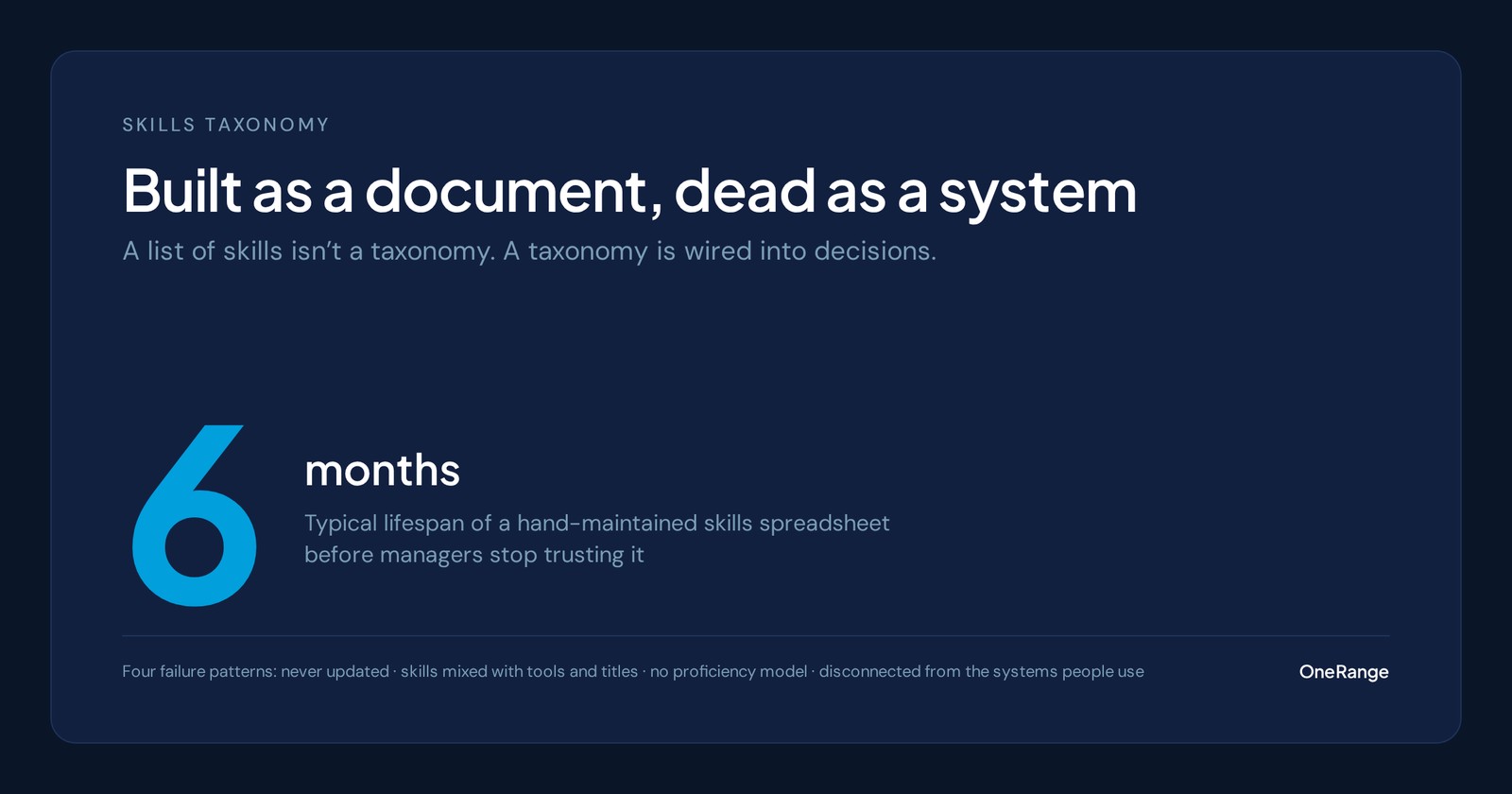
Most skills taxonomies die in a spreadsheet within six months. Here's how to design one that actually drives hiring, training, and internal mobility decisions.
Every HR leader has, at some point, been handed a skills taxonomy. Usually it's a 4,000-row spreadsheet, lovingly maintained for one quarter, and then quietly abandoned when nobody can agree whether 'Python' and 'Python (Advanced)' are the same skill.
The failure isn't effort. Teams pour real hours into these projects. The failure is structural — the taxonomy is built as a document when it needs to be built as a system.
What is a skills taxonomy?
A skills taxonomy is a structured, shared inventory of the skills your organization needs, organized hierarchically, with a defined proficiency model for each skill. It gives hiring, training, and workforce planning one common language: when a job req, a training assignment, and a promotion case all reference the same skill at the same defined level, those three decisions can finally talk to each other.
That last clause is the whole point. A list of skills is not a taxonomy. A taxonomy is a list of skills wired into decisions.
Why do most skills taxonomies fail?
Four patterns account for nearly every dead taxonomy we've seen:
They're built once and never updated. Skills shift faster than annual review cycles. A taxonomy maintained by hand is out of date the quarter after it ships — and once managers notice it's stale, they stop trusting all of it, including the parts that are still right.
They mix skills, tools, and job titles into one flat list. "Communication," "Salesforce," and "Senior Account Manager" are three different kinds of thing. When they sit in one undifferentiated column, every downstream use — search, matching, gap analysis — inherits the confusion.
There's no proficiency model, so "has skill" is a binary flag. Binary skill flags make every employee who has touched a tool equivalent to your expert in it. Nearly every real decision — who's ready for promotion, who needs training, who can mentor — depends on how well, not whether. We've written a full guide to designing proficiency levels that actually mean something.
They're disconnected from the systems people actually use. If the taxonomy lives in a spreadsheet while hiring happens in the ATS and training happens elsewhere, the taxonomy is homework. Nobody does optional homework twice.
How should a skills taxonomy be structured?
Keep the structure boring and the definitions sharp:
Three or four levels of hierarchy, no more. Domain → skill group → skill is enough for most organizations (e.g., Commercial → Sales Execution → Discovery Calls). Deeper trees feel rigorous and die faster, because every level is another thing to maintain.
Separate hard skills from soft skills. Tools and technical capabilities behave differently from behaviors and judgment — they're assessed differently, they decay differently, and they're trained differently. Give them separate branches rather than pretending one rubric fits both.
A named proficiency model on every skill. Four or five levels with behavioral descriptions — what someone at this level can do, not adjectives. "Proficient: runs a full discovery call unassisted and surfaces at least one need the prospect hadn't articulated" beats "Intermediate" every time.
Skills, not roles, as the atomic unit. Roles are bundles of skills that change as the business changes. When you hire and plan around skills rather than roles, the taxonomy survives reorgs; when you build it around job titles, every reorg breaks it.
Start with your five most business-critical roles, not all of them. A taxonomy covering five roles that people actually use beats a complete one nobody opens.
How do you keep a skills taxonomy alive?
The single biggest predictor of whether a skills taxonomy survives is whether it updates itself. Tie it to the work employees actually do — courses they complete, assessments they pass, projects they ship — and let the data refresh proficiency automatically. A taxonomy that requires a human to update every row is a taxonomy that will be out of date in ninety days.
This is where the build-vs-buy question gets real. Maintaining both the skill definitions and current proficiency data for every employee, by hand, is a full-time job that no one is ever actually given. The alternative is to let training and assessment generate the data: every time an employee is assessed or trains, their proficiency record updates as a side effect. That's the approach we take at OneRange — Vero's interactive AI training measures actual skill against a 10,000+ skill taxonomy as people train, so proficiency data stays current without anyone maintaining a spreadsheet.
Whichever route you choose, the test is the same: if you deleted the taxonomy today, would any system notice? If the answer is no, it's shelfware already.
The payoff
Done right, your skills taxonomy becomes the connective tissue between hiring, L&D, and workforce planning — the shared language that lets you spot gaps before they block a launch, report training ROI in terms finance accepts, and fill roles from inside before paying to fill them from outside. Done wrong, it's another spreadsheet nobody opens.
Tags: Skills, Workforce Planning, HR
FAQ
Frequently asked questions
What's the difference between a skills taxonomy and a skills matrix?
A skills matrix maps people against skills for one team, usually in a spreadsheet, at one point in time. A taxonomy is the organization-wide structure underneath — the defined skills, hierarchy, and proficiency levels that matrices, job reqs, and training plans all draw from.
How many skills should a taxonomy include?
As many as you can keep current and no more. Most organizations do better starting with the skills behind their five most critical roles — typically a few hundred — and expanding as automation, not headcount, takes over the maintenance.
Should proficiency levels be self-reported?
Self-ratings are a reasonable seed but a poor steady state — people systematically over- and under-rate themselves. Refresh proficiency from evidence: assessments, completed training, and observed work output.
Related
- Skill assessments in OneRange — How proficiency is measured against a 10,000+ skill taxonomy.
- What AI fluency actually means — The working definition, the four capability bands, and how to measure fluency across a workforce.
- AI readiness: how to assess where your people stand — The dimensions to measure before you buy training, and how to baseline them.