Designing Proficiency Levels That Actually Mean Something
· 8 min read · OneRange Team
Beginner, Intermediate, Advanced mean nothing without behavioral definitions. A practical guide to proficiency levels managers will trust — and how to keep them calibrated
Most proficiency models fail the elevator test. Ask a manager what 'Intermediate Python' means at their company and you'll get five different answers, none of them confident. A proficiency model that nobody can describe is a proficiency model that nobody uses.
What is a proficiency model?
A proficiency model defines the levels at which a skill can be held, and describes each level by observable behavior — what a person at that level can do without help, what they can do with support, and what they can't do yet. It's the measuring stick that makes skill data comparable across people, teams, and time.
Without one, "has the skill" is a binary flag, and every real decision — who's ready for the promotion, who needs training, who should mentor — depends on a distinction the data can't make.
What good levels look like
A useful proficiency level is described by what someone at that level can do without supervision, what they can do with guidance, and what they cannot yet do at all. The labels matter less than the behaviors behind them.
The test is whether two managers reading the same descriptor would place the same person at the same level. If the descriptor is "solid working knowledge," they won't. If it's "can run a full discovery call unassisted and surface at least one need the prospect hadn't articulated," they will.
A four-level model that holds up
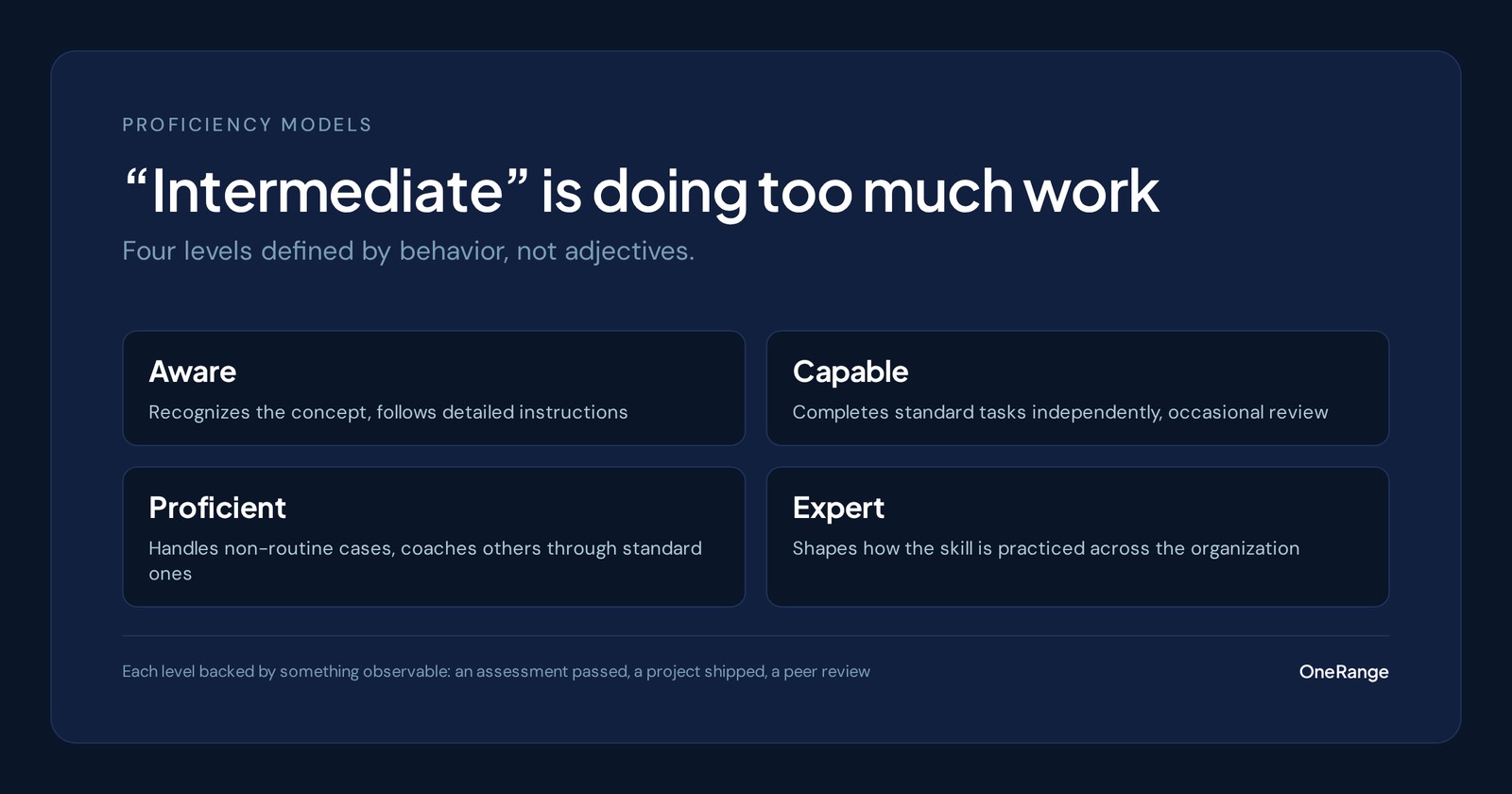
- Aware: can recognize the concept and follow detailed instructions
- Capable: can complete standard tasks independently with occasional review
- Proficient: can handle non-routine cases and coach others through standard ones
- Expert: shapes how the skill is practiced across the organization
Notice what separates each level: supervision at the first boundary, novelty at the second, influence at the third. Those three dimensions travel across almost any skill, which is why this shape survives contact with domains as different as sales and security engineering.
Why most companies stop at three levels
Three feels tidy. The problem is that 'Intermediate' ends up doing too much work — it absorbs everyone from 'finished onboarding' to 'mentors three other people.' Splitting that band into Capable and Proficient gives managers room to actually differentiate, which is the entire point.
Watch out for the opposite failure too. Seven-level models look rigorous and collapse in practice, because nobody can articulate the difference between level four and level five, so everyone defaults to the middle. Four levels, sharply described, beats seven levels nobody can tell apart.
How do you write a level descriptor?
Three rules make descriptors usable:
Lead with a verb, not an adjective. "Configures and troubleshoots standard pipelines" tells a manager something. "Strong technical grasp" does not.
Name the conditions. Unsupervised or reviewed? Routine cases or novel ones? The conditions carry most of the meaning — the same action performed unsupervised on an unfamiliar case is a full level above performing it with guidance on a standard one.
Make it falsifiable. A good descriptor makes it possible to be wrong. If you can't imagine evidence that would move someone down a level, the descriptor is describing a vibe.
The calibration problem
Even good descriptors drift. One manager runs generous, another runs hard, and within two quarters the same rating means different things in different teams — at which point cross-team skill data becomes unusable for planning.
Two things keep a model calibrated. Anchor examples: for each level, a short written example of what that looks like in practice, kept alongside the descriptor. And evidence over opinion — the further you can move ratings from a manager's recollection toward something demonstrated, the less drift you get. Self-ratings are the least reliable input of all; useful as a seed, unreliable as a steady state, since people systematically over- and under-rate themselves in predictable ways.
Tying levels to evidence
Each level should be backed by something observable: an assessment passed, a project shipped, a peer review completed. AI assessments help here because they can probe whether someone is operating at Capable or Proficient on a specific skill, not just whether they 'know' it. That's the level of resolution that makes a proficiency model actually load-bearing.
This is also where proficiency levels stop being an HR artifact and start driving decisions. Levels tied to evidence feed a skills taxonomy that stays current instead of going stale, which is what makes planning around skills rather than roles possible at all. And they're what conversational assessment measures against — the rubric is what turns a conversation into a score you can defend.
OneRange Vero measures skill against a 10,000+ skill taxonomy as people train, so proficiency updates from demonstrated performance rather than from an annual rating exercise.
Tags: Skills, Proficiency, Workforce Planning
FAQ
Frequently asked questions
How many proficiency levels should we use?
Four works for most organizations: enough resolution to differentiate meaningfully, few enough that every level can be sharply described. Three collapses the middle; more than five tends to produce levels nobody can distinguish.
Should proficiency levels be the same for every skill?
Use the same level structure everywhere so data is comparable, but write skill-specific descriptors. "Proficient" should mean the same kind of thing across skills — handles non-routine cases, coaches others — while the concrete behaviors differ between debugging and negotiation.
How often should proficiency ratings be updated?
Continuously, if they're evidence-based — every assessment and completed piece of work is a data point. If ratings depend on a manual review cycle, quarterly is the practical floor; annual ratings are stale before they're published.
Related
- Skill assessments in OneRange — How proficiency is measured against a 10,000+ skill taxonomy.
- What AI fluency actually means — The working definition, the four capability bands, and how to measure fluency across a workforce.
- AI readiness: how to assess where your people stand — The dimensions to measure before you buy training, and how to baseline them.