Is There a Tax Credit for AI Training? The AI Workforce Training Act, Explained
· 8 min read · OneRange Research
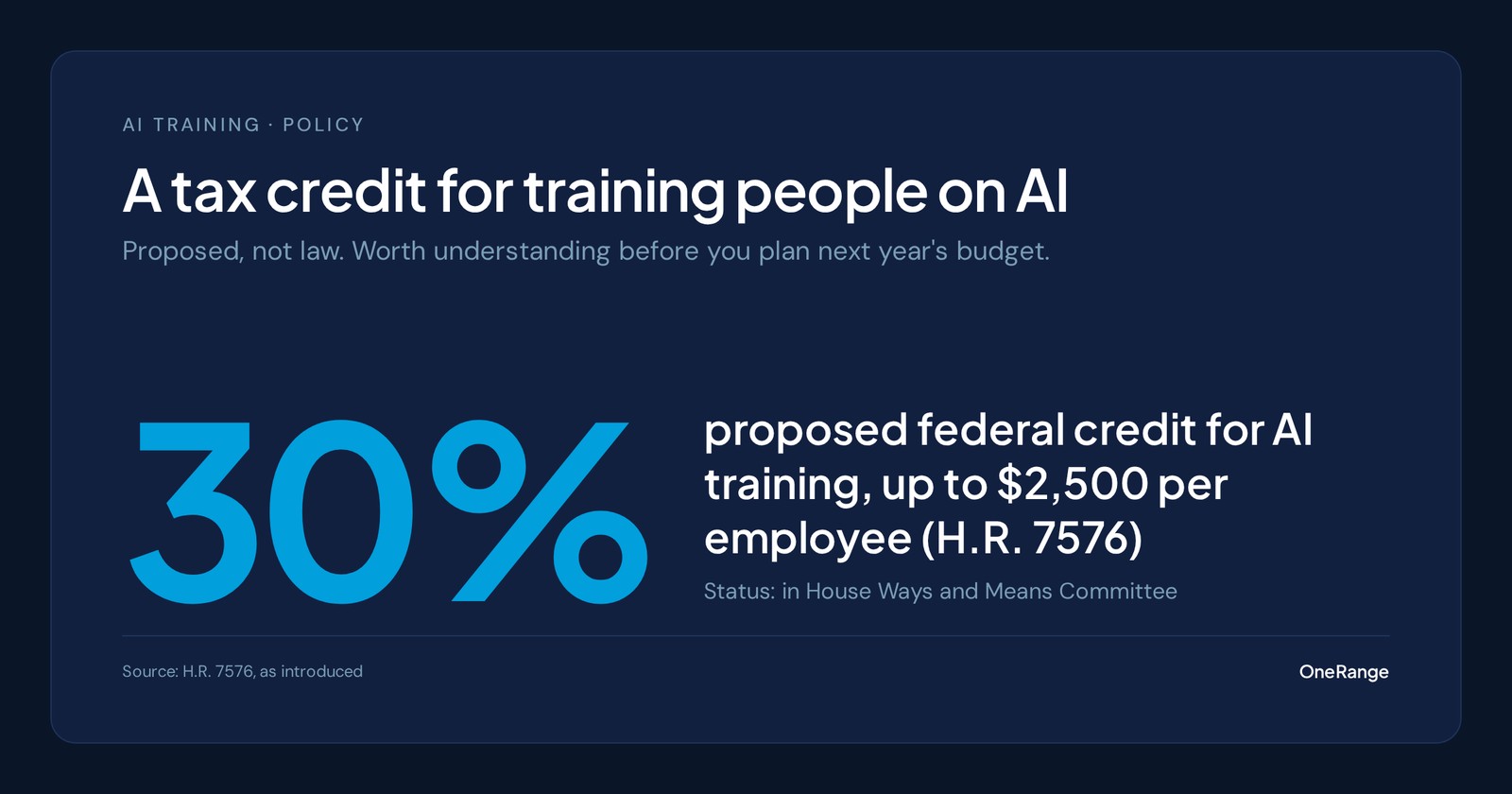
A proposed 30% federal tax credit for AI training is in Congress. What H.R. 7576 would do, where it stands, and the tax rules employers can use today.
This article explains public policy and is not tax advice. Talk to your tax adviser before making decisions based on it.
In February 2026, Representatives Josh Gottheimer (D-NJ) and Mike Lawler (R-NY) introduced a bipartisan bill to make AI training cheaper for employers. It has picked up three more cosponsors since. It hasn't passed, but it signals where federal workforce policy is heading, and employers already have more tax room for AI training than most realize.
What the AI Workforce Training Act would do
| Feature | What H.R. 7576 proposes |
|---|---|
| Credit | 30% of qualified AI training expenses, as a new general business credit (Section 45BB) |
| Cap | The credit can't exceed $2,500 per employee per year, indexed for inflation after 2026 |
| Qualified expenses | Enrollment in accredited AI training programs (workshops, certificates, courses in prompt engineering, data literacy, machine learning fundamentals, or AI ethics); employee wages while attending; and costs of developing or providing in-house AI training |
| Who can claim | Employers that pay for AI training for their employees |
| Double dipping | No other credit or deduction for the same expense, to the extent of the credit |
| Start date | Tax years beginning after December 31, 2025, if enacted |
| Outreach | Treasury, Labor, and Commerce would run a joint campaign to tell businesses, especially small ones, about the credit |
Because the cap applies to the credit, not the spend, an employer would reach the maximum at about $8,333 of qualified spending per employee. Spending $1,500 on an employee's AI training would produce a $450 credit.
Proposed credit per employee at different training budgets (USD)
- $1,000 spend: 300
- $2,500 spend: 750
- $5,000 spend: 1500
- $8,333+ spend: 2500
30% of qualified spend, capped at $2,500 per employee. Illustrative, based on H.R. 7576 as introduced
Where the bill stands
H.R. 7576 was introduced on February 13, 2026 and referred to the House Ways and Means Committee the same day. Representatives Al Green, Shri Thanedar, and James Walkinshaw have since joined as cosponsors. As of September 2026, there has been no hearing, no markup, and no Senate companion bill.
Two open questions matter if it moves. The bill doesn't define an "accredited" AI training program, so it is unclear which providers would qualify. And like any bill, it could change a lot before passage, or never pass.
It isn't the only proposal. The Investing in American Workers Act (S. 3489 and H.R. 6752), introduced in December 2025, would give a 20% credit on increases in training spending for workers earning up to $96,000. It is framed around adapting to AI but isn't AI-specific, and it is also still in committee.
What employers can use today
You don't need to wait for Congress. Existing rules already cover most AI training:
| Option | What it covers | Limit |
|---|---|---|
| Section 162 business deduction | Training that maintains or improves skills employees need in their current jobs | No set cap; must be job-related |
| Section 132(d) working condition fringe | Employer-paid training that would be deductible for the employee; IRS Publication 15-B names AI literacy and skill programs as potential examples | No dollar cap; tax-free to the employee |
| Section 127 educational assistance | Education under a written plan, including courses not tied to the current job and student loan payments | $5,250 per employee per year, tax-free |
| State programs | Examples: New York's Employee Training Incentive Program (a refundable credit, pre-approval needed), California's Employment Training Panel, and the Texas Skills Development Fund | Varies by state and program |
The Publication 15-B change is worth noting. America's AI Action Plan, released in July 2025, directed Treasury to clarify that many AI literacy and skill programs qualify for tax-free treatment. The 2026 edition of IRS Publication 15-B now says employer-provided AI literacy and skill development programs "may be tax-free as working condition fringe benefits if they maintain or improve employee job skills at their current job."
How to get ready either way
- Keep records by employee. Any credit, and any audit of a tax-free benefit, will turn on who was trained, on what, when, and what it cost
- Tie training to the job. Current-job skills are what make training deductible and tax-free under Sections 162 and 132(d)
- Put a Section 127 plan in writing if you want to fund broader learning or student loan help tax-free
- Favor recognized providers. If H.R. 7576 passes with an accreditation test, courses from established providers are more likely to qualify
- Check your state. Training grants and credits in states like New York, California, and Texas often need approval before the training starts
- Treat it as a benefit. Employees increasingly choose employers on AI training; see why workers are teaching themselves AI
How OneRange Atlas helps
Atlas is the upskilling marketplace. Employees choose approved courses and programs from providers like Coursera, Udemy, Maven, and Pluralsight, and every purchase runs through budgets and approvals you set.
- A per-employee record of what was bought, from which provider, when, and for which skill
- Budgets and approvals so spending stays tied to each person's role
- Reporting on learning spend by team and skill, including AI, to share with finance and your tax adviser
Setting a budget? See our guide to the right amount for professional development and how Atlas handles training budget management.
See how Atlas tracks learning spend by employee, provider, and skill.
Sources
- H.R. 7576, AI Workforce Training Act, text as introduced — https://www.govinfo.gov/content/pkg/BILLS-119hr7576ih/html/BILLS-119hr7576ih.htm
- H.R. 7576 bill status (GovInfo) — https://www.govinfo.gov/bulkdata/BILLSTATUS/119/hr/BILLSTATUS-119hr7576.xml
- Rep. Gottheimer, Gottheimer Introduces Bipartisan AI Workforce Training Act (Feb 18, 2026) — https://gottheimer.house.gov/posts/release-gottheimer-introduces-bipartisan-ai-workforce-training-act
- FedScoop, House bill would create AI workforce training tax credit — https://fedscoop.com/ai-workforce-tax-credit-house-bill/
- Sen. Warner, Investing in American Workers Act (Dec 2025) — https://www.warner.senate.gov/newsroom/press-releases/warner-krishnamoorthi-introduce-legislation-to-help-workers-adapt-to-ai-driven-economy/
- IRS Publication 15-B, Employer's Tax Guide to Fringe Benefits — https://www.irs.gov/publications/p15b
- 26 CFR 1.162-5, Expenses for education — https://www.ecfr.gov/current/title-26/chapter-I/subchapter-A/part-1/subject-group-ECFR3eb3ba0a3bba2c5/section-1.162-5
- Mercer, OBBBA makes tax-free student loan reimbursements permanent — https://www.mercer.com/insights/law-and-policy/obbba-makes-tax-free-student-loan-reimbursements-permanent/
- The White House, America's AI Action Plan (Jul 2025) — https://www.whitehouse.gov/wp-content/uploads/2025/07/Americas-AI-Action-Plan.pdf
- New York State, Employee Training Incentive Program — https://www.tax.ny.gov/pit/credits/employee_training_incentive_credit.htm
- California Employment Training Panel — https://etp.ca.gov/about-us/
- Texas Workforce Commission, Skills Development Fund — https://www.twc.texas.gov/programs/skills-development-fund
Tags: AI, Training Budgets, Policy, Learning & Development
FAQ
Frequently asked questions
Is there a federal tax credit for AI training?
Not yet. The AI Workforce Training Act (H.R. 7576) would create a credit of 30% of qualified AI training expenses, up to $2,500 per employee per year, but as of September 2026 it is still in the House Ways and Means Committee. Some states already offer training credits or grants.
Can a business deduct AI training costs today?
Generally, yes. Training that maintains or improves the skills employees need in their current jobs is usually deductible as an ordinary business expense under Section 162.
Is employer-paid AI training taxable to employees?
Usually not. Training that improves skills for an employee's current job can be a tax-free working condition fringe benefit, and IRS Publication 15-B now says employer-provided AI literacy and skill programs may qualify. Section 127 plans can also cover up to $5,250 a year tax-free.
Would H.R. 7576 cover in-house training?
As introduced, yes. Qualified expenses include enrollment in accredited AI training programs, employee wages while they attend, and costs of developing or providing in-house AI training. The bill does not define accredited.
Could a company claim the credit and a deduction for the same expense?
No. Under the bill, no other credit or deduction is allowed for the same expense to the extent of the credit.
Did the Section 127 limit change for 2026?
No. The 2025 tax law made Section 127 student loan payments permanent and indexed the $5,250 limit for inflation, but indexing starts after 2026.
Related
- Training budget management software — Approvals, payment, and spend visibility for external learning in one place.
- OneRange Atlas: the upskilling marketplace — 22,000+ learning resources, AI-matched to each employee, paid for only when they are used.
- Workers Are Teaching Themselves AI Faster Than Employers Train Them — Self-teaching is rising while employer training stays flat, and what that costs you.