Your AI Bill Is Exploding. Upskilling Is the Fix Nobody's Budgeting For
· 12 min read · OneRange Research
Enterprise AI spend hit $37B and 95% of pilots show no ROI. The data says AI upskilling — not more tools — is how companies stop token cost overrun
In April 2026, Uber discovered it had burned through its entire annual AI coding-tools budget — in roughly four months. Microsoft's Experiences & Devices division exhausted its Claude Code budget ahead of schedule and revoked licenses. At Priceline, one engineer ran up $40,000 in token charges in a single month. And the head of the FinOps Foundation says companies started calling him this spring with the same message: "We are 3x over our entire 2026 token budget."
None of these companies bought the wrong AI. They deployed powerful tools to smart people — and skipped the step in between.
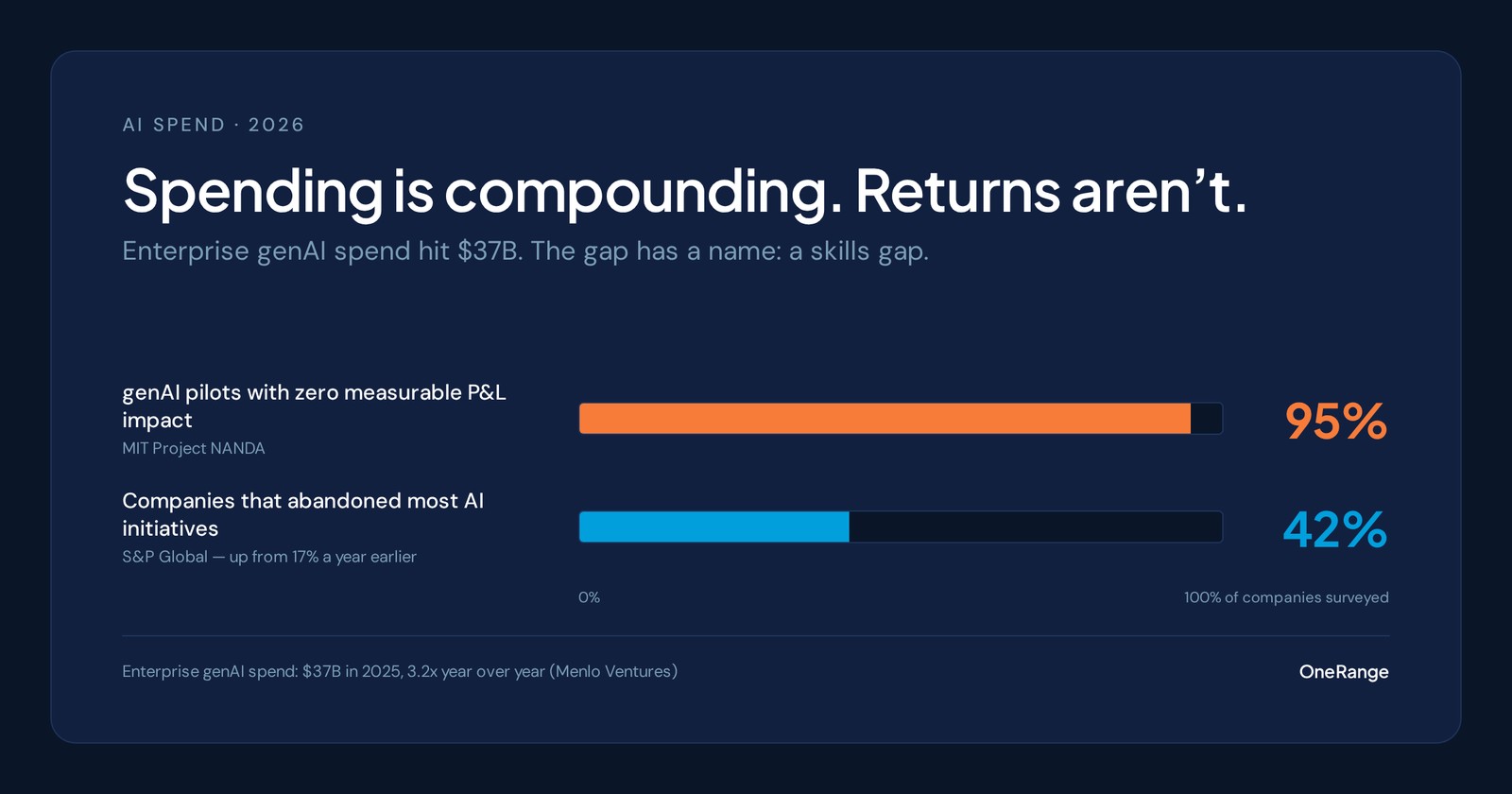
Enterprise generative AI spend hit $37 billion in 2025, up 3.2x year over year, according to Menlo Ventures. Yet MIT's Project NANDA found that 95% of enterprise genAI pilots deliver zero measurable P&L impact. S&P Global reports that 42% of companies abandoned most of their AI initiatives in 2025 — up from 17% a year earlier — with cost as a top-cited obstacle. IBM's CEO study puts it plainly: only 25% of AI initiatives have delivered their expected ROI.
Spending is compounding. Returns aren't. And the gap between the two has a name: it's a skills gap.
- $37B — Enterprise genAI spend 2025 (3.2x YoY (Menlo Ventures))
- 95% — Pilots with zero P&L impact (MIT Project NANDA)
- 42% — Companies that abandoned most AI projects (Up from 17% (S&P Global))
- 25% — AI initiatives hitting expected ROI (IBM CEO Study)
The token problem is a people problem
It's tempting to blame the vendors, and pricing pressure is real. But the data points somewhere more uncomfortable: the biggest variable in your AI bill is how your people use the tools.
Consider what we now know about usage patterns:
- Per-developer token consumption rose ~18.6x in nine months, according to Jellyfish research. Goldman Sachs projects global token usage will grow 24x by 2030
- A Faros AI survey of ~20,000 developers found the heaviest token consumers were about 2x more productive — but used 10x more tokens. That's a 5x efficiency gap between what output justifies and what usage costs
- Gartner now predicts that by 2028, AI coding token costs will exceed the average developer's monthly salary. Six percent of organizations already pay over $2,000 per developer per month in token charges
- Only 22% of finance executives can tie AI spend to business outcomes (CloudZero), and just 37% of organizations have policies to manage AI or detect shadow AI (IBM)
Lab studies vs. real workplace: AI productivity gains
- Harvard/BCG (lab): 40
- GitHub Copilot (lab): 56
- Stanford/MIT (lab): 14
- St. Louis Fed (wild): 5.4
- Chicago BFI (wild): 2.8
Sources: Stanford/MIT, Harvard/BCG, GitHub Copilot RCT; St. Louis Fed, Univ. of Chicago BFI
Untrained usage doesn't just waste money — it creates risk. KPMG's 48,000-person global study found that among employees using AI at work, 66% rely on AI output without evaluating its accuracy and 56% report making mistakes in their work because of AI. IBM found organizations with high levels of "shadow AI" paid $670,000 more per data breach.
Here's the kicker: MIT found workers at over 90% of companies use personal AI accounts for work, while only 40% of companies have official subscriptions. Your people are already all-in on AI. They're just doing it unmanaged, untrained, and often on the wrong tools.
The lab-to-workplace gap is an enablement gap
The research on AI's potential is stunning. In controlled studies, AI delivers 15–55% productivity gains:
- The landmark Stanford/MIT call-center study: 14% average productivity gain — and 34% for less-experienced workers
- Harvard/BCG's experiment with 758 consultants: 12% more tasks completed, 25% faster, 40% higher quality
- GitHub's Copilot trial: developers completed a coding task 56% faster
But in the wild? A University of Chicago study of 25,000 Danish workers across 11 AI-exposed occupations found AI chatbots produced no significant impact on earnings or hours — average real-world time savings of just 2.8%. The St. Louis Fed pegs actual U.S. time savings at 5.4% of work hours among genAI users.
Why do gains of 15–55% in studies collapse to 3–5% in practice? The Chicago study offers the clearest clue: when employers actively encouraged AI use and provided training, adoption nearly doubled — from 47% to 83%. In the lab, every participant is onboarded, guided, and given a well-scoped task. In your office, most employees are handed a login and left alone. The delta isn't the model. It's the enablement.
The training deficit is well documented:
- Only 39% of AI users have received any AI training from their employer (Microsoft/LinkedIn Work Trend Index)
- Only 36% of workers feel adequately trained, even as 72% now use AI regularly (BCG, June 2025)
- Just 15% of desk workers strongly agree they have the education needed to use AI effectively (Slack Workforce Index)
- 65% of workers say they need AI upskilling — and 52% are trying to do it on their own because their employer isn't providing it (Randstad Workmonitor 2026)
The training deficit: workers trained vs. workers using AI
- Received employer AI training: 39
- Use AI without training: 61
Sources: Microsoft/LinkedIn Work Trend Index; BCG AI at Work 2025
What trained employees actually deliver
When companies close that gap, the numbers move — fast.
Trained employees extract multiples more value. Slack's Workforce Index found workers who receive AI training are up to 19x more likely to report that AI improves their productivity. Microsoft found AI "power users" — who save 30+ minutes a day — are 35% more likely to have received role-specific training. BCG identified a concrete threshold: at least five hours of structured training, ideally with in-person coaching, significantly increases the odds an employee becomes a regular, effective AI user.
The market is pricing AI skills at a premium. PwC's 2026 AI Jobs Barometer, built on over a billion job ads, found workers with AI skills now command a 62% wage premium; its 2025 edition found industries most exposed to AI saw ~4x higher growth in revenue per employee (27% vs. 7%). Lightcast data shows AI-skill job postings pay ~$18,000 more per year — and 51% of them are now outside IT.
The ROI math works. IDC research found companies realize an average of $3.70 for every $1 invested in generative AI — with top performers seeing roughly $10. The difference between average and top? Overwhelmingly organizational: process redesign, governance, and skills. That's why JPMorgan now gives every new hire prompt-engineering training, and why IKEA retrained 8,500 call-center agents into design consultants after AI absorbed ~47% of inbound queries — a reskilled channel that generated €1.3 billion in revenue.
Return per $1 invested in generative AI
- Average company: 3.7
- Top performers: 10
Source: IDC, The Business Opportunity of AI (2024)
Want to run these numbers against your own headcount, hourly cost, and adoption rate? The free calculator below does it in seconds — no email required.
Calculate your AI training ROI
The skill your budget feels most: right model, right task
Most AI training covers prompting. Almost none covers the single behavior with the largest direct cost impact: model selection.
Model pricing spans an enormous range. As of mid-2026, frontier models run $10–$15 per million input tokens (with output up to $50–$90), while capable small models cost as little as $0.10–$1.00. That's a 10x to 150x price spread for the same API call — and for a huge share of everyday tasks, the cheap model is enough:
- Anthropic's own benchmarks showed Claude Haiku 4.5 delivering similar coding performance to a mid-tier model at one-third the cost and twice the speed
- NVIDIA researchers argue small models suffice for most repetitive agent work — at 10–30x lower cost per token
- Berkeley's RouteLLM showed intelligent routing between a frontier and a small model can cut costs by up to 85% while retaining 95% of frontier-level quality. AWS reports up to 30–60% savings from prompt routing at matched quality
- Settings matter as much as models: benchmarks from Artificial Analysis found a single model used 23x more tokens at high reasoning effort than at minimal — same model, same price sheet, wildly different bill
- Table stakes most employees have never heard of: prompt caching (up to 90% off repeated context) and batch processing (50% off at every major provider)
Model pricing spread: input cost per 1M tokens (USD)
- Small (Haiku-class): 1
- Mid-tier: 3
- Frontier: 15
Illustrative mid-2026 list prices across small vs. frontier tiers
An employee who defaults to the most expensive model with maximum reasoning for routine summarization isn't being thorough. They're being untrained — at a 20–100x markup, thousands of times a day across your company.
The playbook: five actionable moves
- Set a training floor of five hours — with coaching. BCG's data shows five-plus hours of structured, coached training is the threshold that turns tool-havers into regular users. A lunch-and-learn is not a training program
- Teach model-tier fluency, not just prompting. Every employee who touches AI should learn the three-tier habit: start with the fast, cheap model; escalate to mid-tier when quality falls short; reserve frontier models (and extended reasoning) for genuinely hard problems. For technical teams, add caching, batching, and routing. This one module pays for itself in weeks
- Make training role-specific. Microsoft's data is clear: power users are 35% more likely to have received role-specific training. Generic "intro to ChatGPT" sessions don't move marketers, analysts, and engineers the same way workflows built around their actual tasks do
- Pair L&D with FinOps. The FinOps Foundation reports 98% of cloud finance teams now manage AI costs, up from 31% two years ago — and names AI cost skills the most in-demand capability. Share token dashboards by team. When employees can see cost per task, efficient behavior follows. What gets measured gets trained
- Give employees ownership of their learning. Randstad found 52% of workers are upskilling on AI on their own because employers aren't keeping up, and 47% fear AI benefits the company more than them. Personalized learning budgets and employee-directed resources let your people chase the skills their role needs now, and signal that AI fluency is an investment in them, not just in headcount reduction
The bottom line
The companies winning with AI aren't the ones spending the most — BCG found AI leaders are pulling 1.7x revenue growth ahead of laggards, and only 5% of companies have reached that tier. What separates them isn't tool access; 88% of companies now use AI somewhere. It's that they built the human capability layer: people who know which model to reach for, how to direct it, and how to check its work.
Your AI spend is already a permanent budget line. The question is whether the skills line item keeps pace. Every dollar of training is leverage on every token you buy.
OneRange helps companies put upskilling budgets to work — giving every employee access to the courses, coaching, and resources they need to build AI fluency for their role.
Sources
- Menlo Ventures, 2025: The State of Generative AI in the Enterprise (Dec 2025) — https://menlovc.com/perspective/2025-the-state-of-generative-ai-in-the-enterprise/
- MIT Media Lab / Project NANDA, The GenAI Divide: State of AI in Business 2025 (Aug 2025), via Fortune — https://fortune.com/2025/08/19/shadow-ai-economy-mit-study-genai-divide-llm-chatbots/
- S&P Global Market Intelligence, Voice of the Enterprise: AI & Machine Learning (2025), via CIO Dive — https://www.ciodive.com/news/AI-project-fail-data-SPGlobal/742590/
- IBM Institute for Business Value, CEO Study (May 2025) — https://newsroom.ibm.com/2025-05-06-ibm-study-ceos-double-down-on-ai-while-navigating-enterprise-hurdles
- TechCrunch, The token bill comes due (Jun 5, 2026) — Uber, Microsoft, Priceline, FinOps Foundation, Jellyfish, Faros AI, Goldman Sachs figures — https://techcrunch.com/2026/06/05/the-token-bill-comes-due-inside-the-industry-scramble-to-manage-ais-runaway-costs/
- Gartner token-cost prediction (Jun 2026), via TechTimes — https://www.techtimes.com/articles/319333/20260629/ai-coding-costs-can-drain-budget-days-gartner-predicts-they-will-match-developer-pay.htm
- CloudZero, The State of AI Costs 2025 (May 2025) — https://www.cloudzero.com/state-of-ai-costs/
- KPMG × University of Melbourne, Trust, Attitudes and Use of AI: A Global Study 2025 (Apr 2025) — https://kpmg.com/xx/en/media/press-releases/2025/04/trust-of-ai-remains-a-critical-challenge.html
- IBM, Cost of a Data Breach Report 2025 (Jul 2025) — https://newsroom.ibm.com/2025-07-30-ibm-report-13-of-organizations-reported-breaches-of-ai-models-or-applications,-97-of-which-reported-lacking-proper-ai-access-controls
- Brynjolfsson, Li & Raymond, Generative AI at Work (NBER w31161; QJE 2025) — https://www.nber.org/papers/w31161
- Dell'Acqua et al. (Harvard × BCG), Navigating the Jagged Technological Frontier (2023; Organization Science 2025) — https://aiinstitute.hbs.edu/navigating-the-jagged-technological-frontier/
- Peng et al., GitHub Copilot RCT (2023) — https://arxiv.org/abs/2302.06590
- Humlum & Vestergaard, Large Language Models, Small Labor Market Effects (Univ. of Chicago BFI, Apr 2025) — https://bfi.uchicago.edu/wp-content/uploads/2025/04/BFI_WP_2025-56-1.pdf
- Federal Reserve Bank of St. Louis, The Impact of Generative AI on Work Productivity (Feb 2025) — https://www.stlouisfed.org/on-the-economy/2025/feb/impact-generative-ai-work-productivity
- Microsoft & LinkedIn, 2024 Work Trend Index (May 2024) — https://news.microsoft.com/source/2024/05/08/microsoft-and-linkedin-release-the-2024-work-trend-index-on-the-state-of-ai-at-work/
- BCG, AI at Work 2025: Momentum Builds, but Gaps Remain (Jun 2025) — https://www.bcg.com/publications/2025/ai-at-work-momentum-builds-but-gaps-remain
- BCG, The Widening AI Value Gap (Sep 2025) — https://www.bcg.com/press/30september2025-ai-leaders-outpace-laggards-revenue-growth-cost-savings
- McKinsey, The State of AI: Global Survey 2025 (Nov 2025) — https://www.mckinsey.com/capabilities/quantumblack/our-insights/the-state-of-ai
- Slack Workforce Index (Jun 2024) — https://slack.com/blog/news/the-workforce-index-june-2024
- Randstad, Workmonitor 2026 — https://www.randstad.com/press/2026/randstad-releases-new-workmonitor-2026-report/
- PwC, Global AI Jobs Barometer 2026 — https://www.pwc.com/gx/en/news-room/press-releases/2026/pwc-2026-ai-jobs-barometer.html
- PwC, Global AI Jobs Barometer 2025 — https://www.pwc.com/gx/en/news-room/press-releases/2025/ai-linked-to-a-fourfold-increase-in-productivity-growth.html
- Lightcast, Beyond the Buzz (Jul 2025) — https://lightcast.io/resources/blog/beyond-the-buzz-press-release-2025-07-23
- IDC (commissioned by Microsoft), The Business Opportunity of AI (Nov 2024) — https://blogs.microsoft.com/blog/2024/11/12/idcs-2024-ai-opportunity-study-top-five-ai-trends-to-watch/
- JPMorgan prompt-engineering training, via CIO Dive — https://www.ciodive.com/news/jpmorgan-chase-ai-training-strategy-prompt-engineering-/717273/
- IKEA/Ingka reskilling case, via PYMNTS — https://www.pymnts.com/news/artificial-intelligence/2026/ikea-turned-8500-call-agents-into-design-consultants/
- Anthropic pricing — https://platform.claude.com/docs/en/about-claude/pricing
- Anthropic, Claude Haiku 4.5 announcement — https://www.anthropic.com/news/claude-haiku-4-5
- OpenAI pricing — https://developers.openai.com/api/docs/pricing
- Google Gemini pricing — https://ai.google.dev/gemini-api/docs/pricing
- NVIDIA Research, Small Language Models are the Future of Agentic AI (2025) — https://arxiv.org/abs/2506.02153
- LMSYS/UC Berkeley, RouteLLM (Jul 2024) — https://www.lmsys.org/blog/2024-07-01-routellm/
- AWS, Amazon Bedrock Intelligent Prompt Routing — https://aws.amazon.com/blogs/machine-learning/use-amazon-bedrock-intelligent-prompt-routing-for-cost-and-latency-benefits/
- Artificial Analysis, GPT-5 benchmarks (Aug 2025) — https://artificialanalysis.ai/articles/gpt-5-benchmarks-and-analysis
- Anthropic, Prompt caching — https://claude.com/blog/prompt-caching
- FinOps Foundation / Linux Foundation, State of FinOps 2026 (Feb 2026) — https://data.finops.org/
- Gallup, AI Use at Work Rises (Q3 2025) — https://www.gallup.com/workplace/699689/ai-use-at-work-rises.aspx
Tags: AI, Cost Optimization, Learning & Development, Thought Leadership
Related
- What AI fluency actually means — The working definition, the four capability bands, and how to measure fluency across a workforce.
- OneRange Vero: interactive AI training — Interactive AI training built from your own source material and adapted to every role and level.
- AI training for managers and leaders — Twenty-one courses on use cases, pilots, policy, change, measurement, and running an AI programme.