Adaptive Training Is Finally Here — And It Starts With a Competency Baseline
· 6 min read · OneRange Team
For decades, 'meet learners where they are' was a slogan. Now it's an operating model. Here's how a short competency baseline at the start of every course turns generic training into a personalized path
Every learning leader has said it: training should meet people where they are. The trouble is that for most of the last twenty years, the technology to actually do that didn't exist at scale. So companies bought course libraries, assigned them to everybody, and pretended a 12-year veteran and a brand-new hire were going to get the same value out of the same 45-minute video.
That gap is finally closing. Adaptive training — the kind that genuinely adjusts to each learner's existing knowledge — is now practical, fast to deploy, and measurable. The piece that makes it work isn't the AI on top. It's the diagnostic at the bottom.
The competency baseline: 90 seconds that change the next 90 minutes
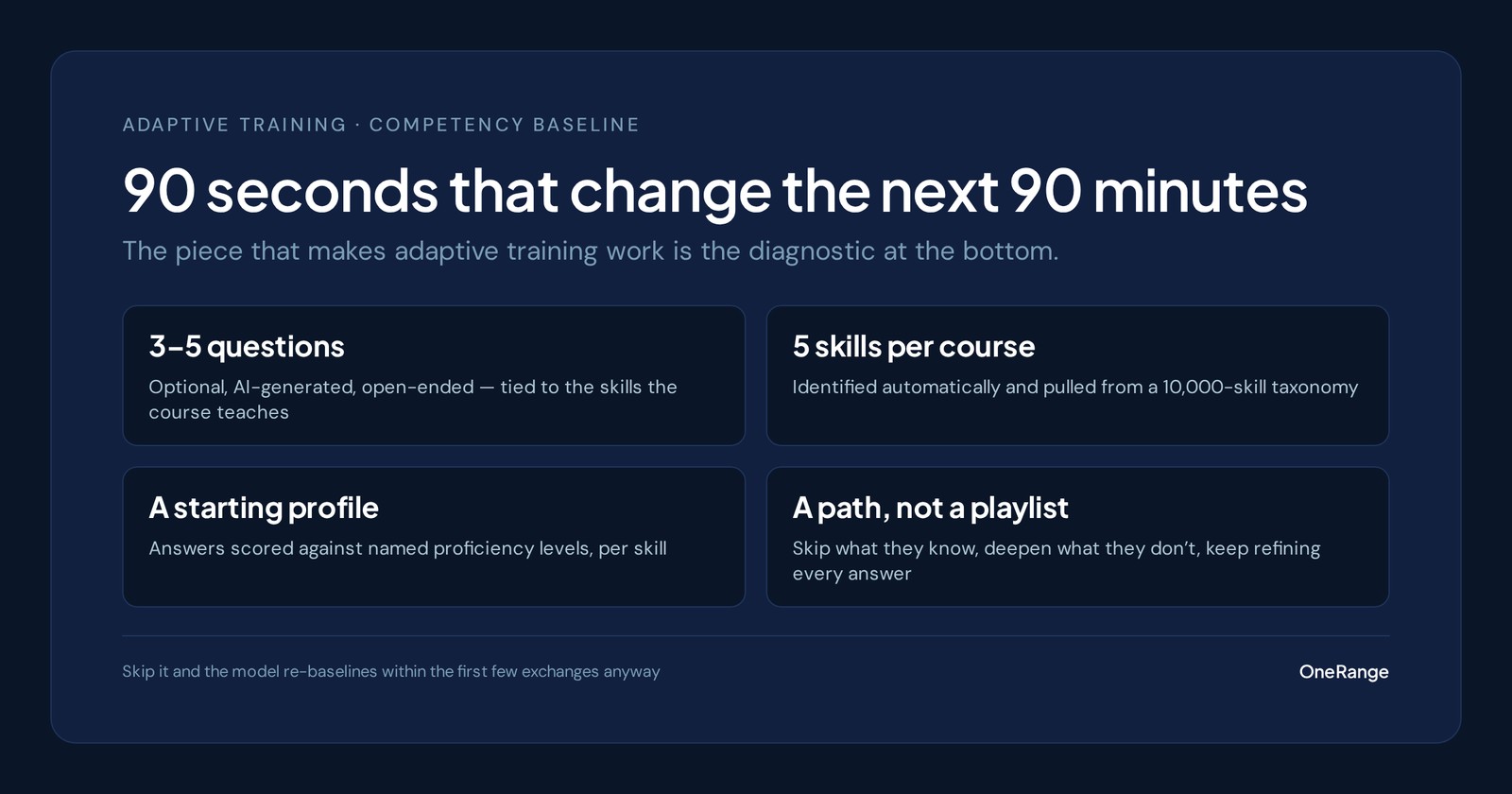
At OneRange, every course begins with an optional, lightweight competency baseline — typically 3 to 5 short, AI-generated questions tied to the skills the course covers. Learners can opt in or skip. If they opt in, the system uses their answers to set their starting point on each skill before the real training begins.
The result: an experienced engineer doesn't sit through a primer they wrote three years ago. A first-time manager doesn't get thrown into a senior-level case study with no scaffolding. Each learner gets a path calibrated to where they actually are, not where the cohort average is.
How it works under the hood
- When a course is created, OneRange's AI identifies the exact 5 skills it teaches and pulls them from a 10,000-skill taxonomy
- The baseline generates a few open-ended questions per skill — not multiple choice — so the answers reveal reasoning, not recognition
- Responses are scored against a proficiency model with named levels, producing a starting profile per skill
- The training engine uses that profile to skip what the learner already knows, deepen what they don't, and pace the rest accordingly
- Every subsequent answer continues to refine the profile, so the path keeps adapting through the course
Why a baseline beats a placement test
Traditional placement tests are long, heavy, and gated. Learners avoid them, and L&D teams avoid building them. A competency baseline is the opposite: short enough that nobody objects to it, embedded in the flow so it's not a separate event, and continuously corrected by the training itself. Even when learners skip it, the model has them re-baselined within the first few exchanges of the conversation.
What changes for the organization
- Time to competency drops because nobody re-learns what they already know
- Engagement rises because the content stops being insulting to experts and overwhelming to beginners
- Skill data is current the moment a learner finishes — no separate assessment cycle required
- Managers see proficiency movement, not just completion percentages
Meeting the standard, not just the learner
Adaptive training isn't about lowering the bar. The endpoint is fixed: every learner exits the course at the proficiency standard the organization defines. The path to that standard is what flexes. Some people get there in twelve minutes; others get there in forty. Both arrive at the same place — and you have the data to prove it.
The bigger shift
For decades, meeting learners where they are was a value statement on a slide. Now it's a default behavior of the platform. The competency baseline is small — three to five questions — but it's the hinge that turns a generic course into a personalized program. That's what makes adaptive training real, and it's why the teams using it are pulling away from the ones still assigning the same content to everyone.
Tags: AI Training, Skills Assessment, L&D, Proficiency
Related
- What AI fluency actually means — The working definition, the four capability bands, and how to measure fluency across a workforce.
- OneRange Vero: interactive AI training — Interactive AI training built from your own source material and adapted to every role and level.
- The best AI training platforms in 2026 — An honest comparison of the platforms buying teams shortlist, and who each one actually fits.