Partner Enablement, Explained: Why Training External Teams Is Different
· 5 min read · OneRange Team
Partner enablement means training people you don't manage to sell a product you do. Here's why it breaks internal L&D playbooks — and what works instead.
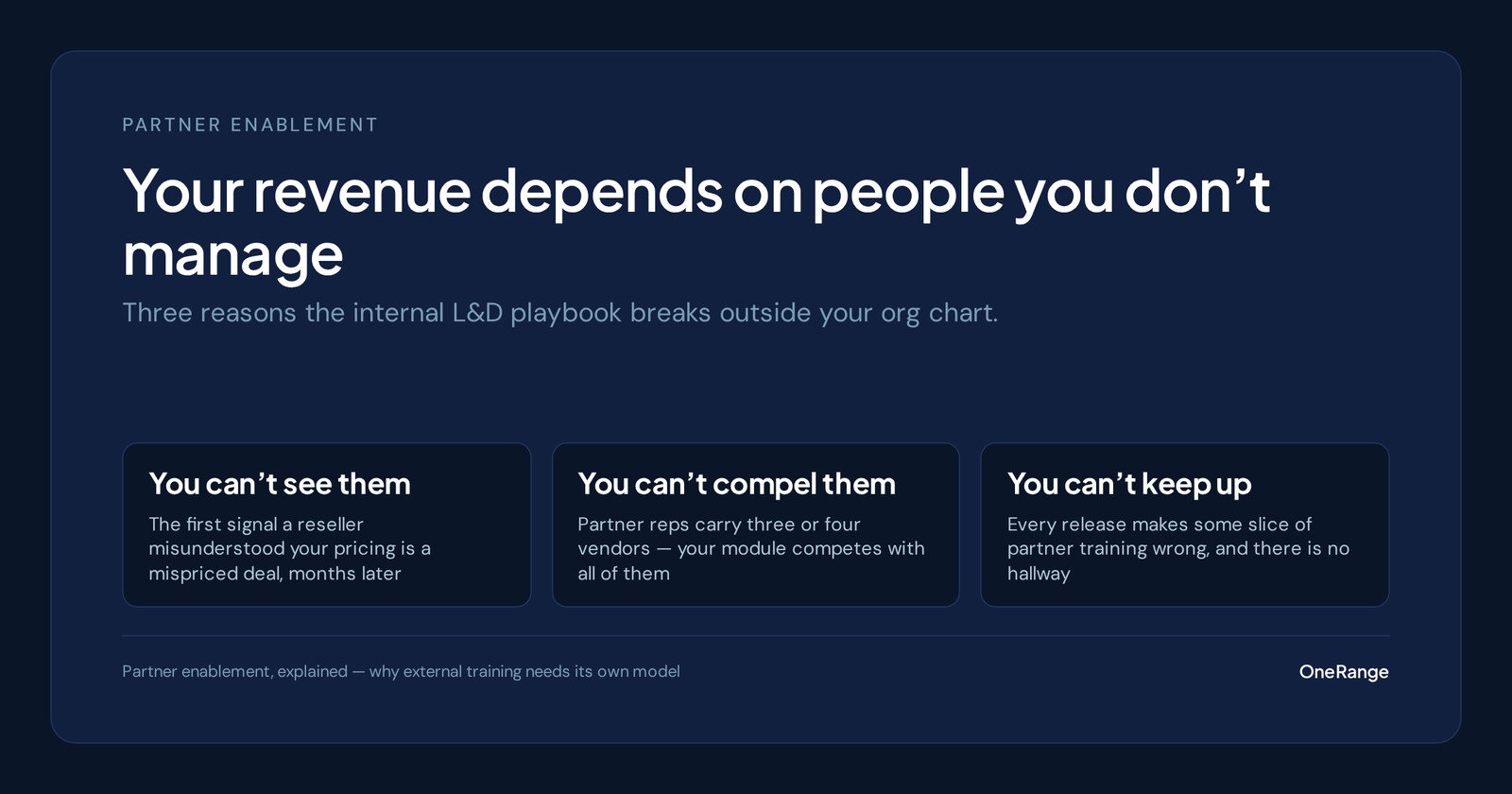
Your revenue increasingly depends on people who don't work for you. Channel partners, resellers, implementation shops, service partners — every one of them represents your product to customers, and none of them sits in your org chart. Partner enablement is the discipline of making those external teams as good at your product as your own people are. Most companies run it like internal training, and that's why most of it fails.
What is partner enablement?
Partner enablement is the practice of equipping external organizations — resellers, channel partners, and service partners — with the product knowledge and skills they need to sell, implement, and support your product well. It spans onboarding new partners, keeping existing ones current as the product changes, and measuring whether any of it worked.
The definition sounds like corporate training with the audience swapped. The economics are entirely different.
Three ways external training breaks the internal playbook
You can't see them. With employees, skill gaps eventually surface — in one-on-ones, in performance reviews, in the deal your rep asks for help on. Partner reps ramp invisibly. The first signal that a reseller never understood your pricing model is a mispriced deal or a churned customer, months after the damage started.
You can't compel them. Your partners' reps carry three or four vendors' products. Your training competes for their attention against every other vendor's portal, and against their actual job. An internal team will sit through a mandatory 45-minute module; a partner rep abandons it eleven minutes in and you'll never know.
You can't keep up with yourself. Every product release makes some slice of your partner training wrong. Internally, hallway knowledge covers the gap between releases and course updates. Externally there is no hallway. Whatever your partners learned at certification is what they'll say to customers until you retrain them — and rebuilding course content for every release is a job nobody staffs.
Why the standard fix falls short
The standard fix is a partner portal: an LMS seat for every partner rep, a library of courses, a certification quiz at the end. It solves distribution and proves attendance. It doesn't solve the three problems above — visibility, attention, or currency. A completion certificate tells you a rep clicked through the material once. It can't tell you whether they can handle a pricing objection today, on the version of the product you shipped last month. (We've written about why completion rates are the wrong measure of partner training — the trap is that they're easy to report and comfortable to believe.)
What good partner enablement looks like
The programs that work share three properties, whatever tooling they run on.
Training generated from the source of truth, not authored alongside it. The documentation, help center, and enablement decks you already maintain are the most current description of your product that exists. When training derives from that material directly — rather than from courses built about it — currency stops being a maintenance project. This is how OneRange Vero approaches partner enablement: interactive AI training generated from the company's own source material, with citations, so partners learn the product as it actually is.
Adaptation to the partner's context. A new reseller rep in one market and a ten-year services partner in another need different depth on different topics. Static courses give both the same hour. Adaptive training starts where each rep actually is, which is also the only realistic answer to the attention problem — partners finish training that respects what they already know.
Skill measurement, not activity measurement. The question that matters is "which partners are ready to represent us, and where are the gaps?" That requires measuring what reps can actually do — and it changes the relationship. Instead of nagging partners about completion, you can show up with "your team is strong on the platform, shaky on the new integrations — here's a targeted session," which is help, not homework.
Where to start
Pick your ten most important partner organizations and answer one question honestly: for each, do you know — with evidence — whether their reps can demo, price, and position your product today? If the answer is a completion report, you have a visibility problem before you have a training problem. Solve that first, and the rest of partner enablement gets dramatically easier.
Tags: Partner Enablement, Training, Thought Leadership
FAQ
Frequently asked questions
What's the difference between partner enablement and sales enablement?
Sales enablement equips your own sellers; partner enablement equips external organizations that sell or service your product. The core difference is control: partners choose how much attention to give you, and you can't see their gaps through normal management channels — so visibility and adaptation matter far more.
Who owns partner enablement in an organization?
Usually the channel or partnerships team, sometimes with support from sales enablement or customer education. Ownership matters less than instrumentation: whoever owns it needs evidence of partner skill, not just content distribution.
How do you measure partner enablement?
Measure readiness, not activity: skill levels by partner organization and rep, time for a new partner to reach selling proficiency, and gap closure after targeted training. Completion rates and portal logins measure attention, not ability.
Related
- Partner enablement with Vero — Train external partners with interactive AI training and prove they can sell.
- OneRange Vero: interactive AI training — Interactive AI training built from your own source material and adapted to every role and level.
- The ROI of AI training — How to build a defensible business case for AI training spend.