How to Calculate the Real ROI of AI-Powered Training (With a Worked Example)
· 8 min read · OneRange Team
Most training ROI calculations are vibes dressed up as math. Here's a concrete formula, a worked example, and the four numbers your CFO will actually accept
Every L&D leader has been asked, usually right before budget season, to prove the ROI of training. The honest answer most teams give is some mix of completion rates, satisfaction scores, and a hopeful anecdote. None of that survives contact with a finance team.
The good news: you can compute a defensible ROI number in an afternoon. The bad news: it requires picking metrics that aren't comfortable, and being willing to subtract the cost of the program from the gain.
The formula
ROI (%) = (Annualized gain − Total cost) / Total cost × 100. Annualized gain is the dollar value of measurable behavior change. Total cost includes platform fees, content, and learner time at fully loaded salary.
The four numbers that drive it
- Time-to-productivity reduction: how many fewer days to reach the proficiency bar, multiplied by daily fully loaded cost per learner
- Error or rework reduction: dollar value of mistakes prevented, often the largest line in technical or compliance training
- Retention lift: trained employees who stay an extra year save the replacement cost of that role (typically 50-200% of salary)
- Internal mobility uplift: roles filled internally instead of externally save recruiting fees and ramp time
A worked example
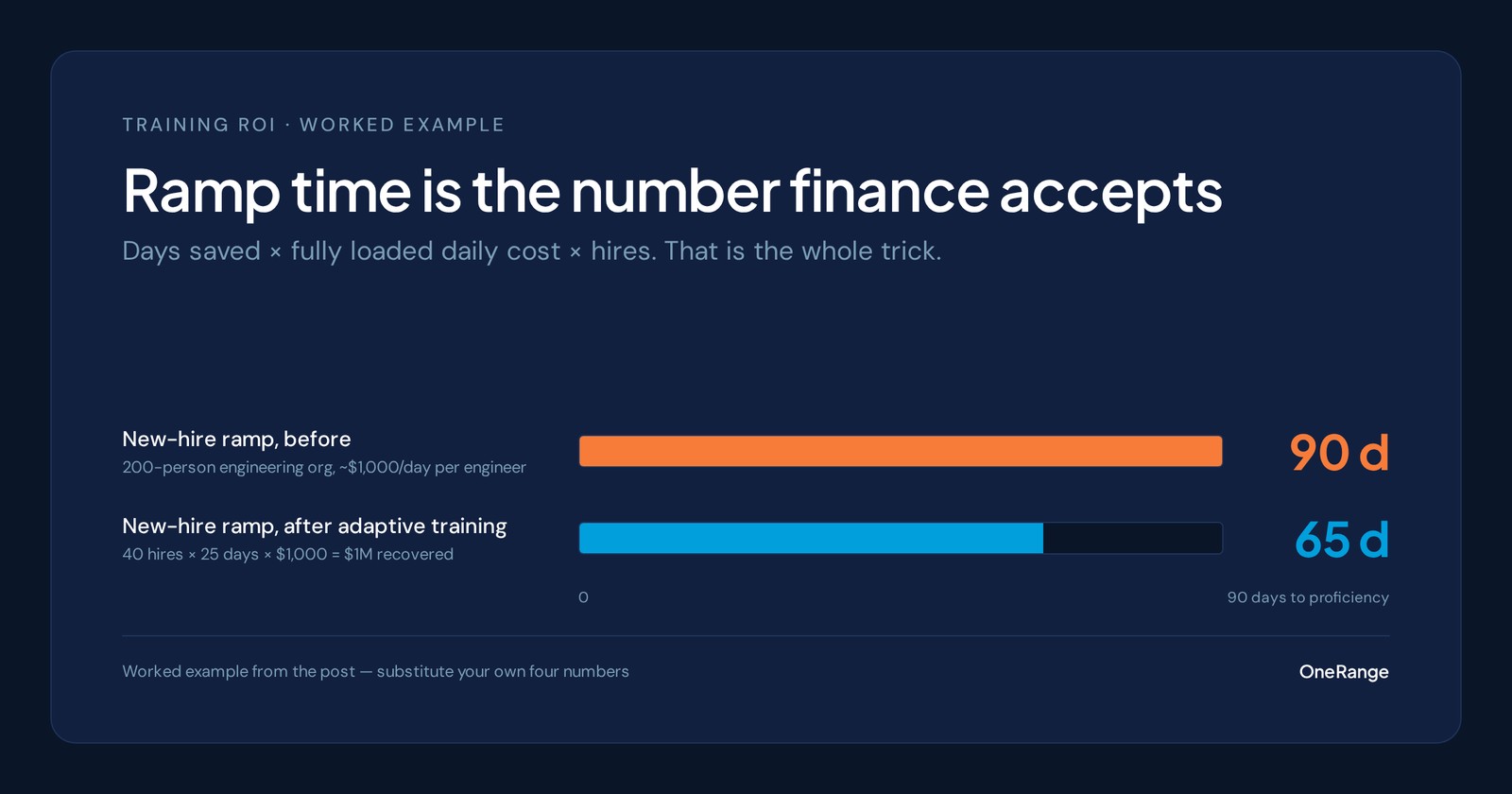
Picture a 200-person engineering org. Average fully loaded cost per engineer: $250K/year, or roughly $1,000/day. Adaptive training shortens new-hire ramp from 90 days to 65 days. With 40 hires per year, that's 40 × 25 × $1,000 = $1,000,000 in recovered productivity. Add a conservative $300K from reduced incident rework on a new platform rollout. Total annualized gain: $1.3M.
Total cost: $120K platform, $80K content and admin time, $200K learner time (5 hours per quarter × 200 engineers × $200/hour). Total: $400K. ROI = (1,300,000 − 400,000) / 400,000 = 225%.
What CFOs push back on
Be ready to defend two things: how you measured the productivity gain (use a clear before/after on a real outcome, not self-report) and whether the gain would have happened anyway. The second question is fair. Run a small holdout cohort if you can — the credibility uplift is worth more than the lost coverage.
Why AI-powered training raises the ceiling
Traditional training caps the gain side of the equation because the content is generic and the consumption is slow. Adaptive training produces measurably faster time-to-competency and produces skill-level data you can tie back to outcomes. That's not a marketing claim — it's what makes the ROI calculation defensible in the first place.
Related
- The ROI of AI training — How to build a defensible business case for AI training spend.
- How to calculate AI training ROI — The formula, the inputs worth trusting, and the KPIs to report upward.
- AI training ROI calculator — Model the return on a training program with your own headcount and salary inputs.